
Online Casino Payment Methods: Deposits & Withdrawals for UAE Players
The main casino payment methods are cards, bank transfers, e-wallets, prepaid vouchers and cryptocurrency — but no method works at every casino, and a method that lets you deposit does not always let you withdraw. Before you choose, check what the operator’s cashier supports for both directions, what it costs, and how long a payout takes.
How you pay in and get paid out shapes the whole experience of an online casino more than most players expect. Fees, limits and processing times differ by method and by operator, the currency of your account decides whether every deposit is converted, and the identity checks needed before a first withdrawal can add days if you leave them to the end. For players in the UAE there is a further layer: banks may decline gambling transactions, payment providers set their own rules, and whether a casino is allowed to take your money at all is a legal question that no payment method answers. This guide covers all of it, method by method.

Best Online Casino Payment Methods
There is no single best method — the right one is the one your casino supports for withdrawals, at a cost and speed you can accept. The table compares the main types on what is true across the market; exact fees, limits and times are set by each operator and provider, so we do not quote figures that would be wrong for your casino.
| Method | Deposits | Withdrawals | Check before you use it |
|---|---|---|---|
| Visa / Mastercard | Widely offered | Depends on the operator | Your bank may decline gambling payments; credit cards can add cash-advance fees |
| Apple Pay / Google Pay | Where offered | Usually paid back to the card behind it, if at all | A digital wallet uses your card, so your bank’s rules still apply |
| Bank transfer | Offered by many operators | Commonly offered | Slowest to arrive; your bank and intermediary banks may charge |
| E-wallets (Skrill, Neteller, MuchBetter) | Where offered | Where offered | Wallet fees and currency conversion; some bonuses exclude e-wallet deposits |
| Prepaid vouchers (Paysafecard) | Where offered | Rarely — vouchers are built for paying, not receiving | You will need a second method to withdraw |
| Cryptocurrency (Bitcoin, USDT) | Where offered | Where offered | Price swings, irreversible transfers, network fees, and UAE rules on payment tokens |
| PayPal | Rarely | Rarely | PayPal only allows gambling payments with its prior approval and where gambling is legal |
| KNET | Kuwaiti cards only | — | KNET is Kuwait’s national network; it does not apply to UAE bank cards |
Market overview checked on 12 October 2026. Availability is set by each casino — the cashier, not this table, is the final word.


Casinos We Rate and the Payment Methods They List








Casino Payment Methods by Category
Each group of methods has a different trade-off between speed, cost, privacy and the chance of a payout going through.
Card Payments
Visa and Mastercard debit and credit cards are the most familiar way to deposit. Deposits are normally immediate once approved, but gambling transactions carry their own merchant category code (MCC 7995), which card networks treat as high-risk and which many issuing banks decline by default. Withdrawals back to a card are possible at some operators and not others. With a credit card, your bank may treat a casino payment as a cash advance, with its own fee and interest from day one.
Bank Transfers
A direct transfer suits larger amounts and is one of the methods most commonly offered for withdrawals. It is also usually the slowest: the casino processes the request, then the payment moves between banks, sometimes through an intermediary bank that takes a fee. International transfers into a UAE account can be converted from USD or EUR on the way.
E-Wallets
An e-wallet such as Skrill, Neteller or MuchBetter sits between your bank and the casino, so the casino never sees your card or account details. Where an operator supports them for both deposits and withdrawals, e-wallets are often among the faster ways to get paid. The costs to watch are the wallet’s own fees for loading and withdrawing, currency conversion inside the wallet, and bonus terms — some casinos exclude e-wallet deposits from welcome offers.
Prepaid Vouchers
Paysafecard and similar vouchers let you deposit with a code bought in advance, without sharing bank details. They are good for keeping to a fixed budget, but they are built for paying, not receiving: expect to need a bank transfer or e-wallet to withdraw.
Cryptocurrency
Many international casinos accept Bitcoin, USDT and other cryptocurrencies, and crypto casinos are a large share of what UAE players search for. Crypto deposits and withdrawals can be quick once approved, but the risks are real: prices move between deposit and withdrawal, a transfer sent to the wrong address cannot be reversed, network fees vary, and the casino still applies identity checks before paying out. In the UAE, the Central Bank’s Payment Token Services Regulation (2024) restricts which tokens may be used as a means of payment and limits the use of foreign stablecoins — one more reason to treat crypto as a method with legal as well as practical questions.
KNET and Gulf Payment Networks
KNET is Kuwait’s national electronic payment network, set up by Kuwaiti banks, and it processes payments made with Kuwaiti bank cards. It is not a UAE payment method: a card issued by a UAE bank runs on Visa, Mastercard or the bank’s own network, not on KNET. It is only relevant to players who hold a Kuwaiti bank card.
Each Gulf country has its own national network in the same way: Mada in Saudi Arabia, BENEFIT in Bahrain, NAPS in Qatar and OmanNet in Oman. The UAE launched its own domestic card scheme, Jaywan, in 2025, run by Al Etihad Payments, alongside the instant account-to-account platform Aani. These networks are built mainly for domestic payments; international casinos rely on Visa, Mastercard and the other methods above, so a national scheme logo on a casino’s payment page is not something to expect.
Card Payments in Depth
Cards are the method most players try first, and the one most likely to be declined. Knowing why helps you read what happens at the cashier.
Why Gambling Card Payments Are Treated Differently
Every card payment carries a merchant category code that tells your bank what kind of business is being paid. Online gambling uses code 7995, which card networks classify as high-risk. Banks decide for themselves what to do with it, and many in the UAE decline it by default. Some casinos route payments through a processor whose name, not the casino’s, appears on your statement — check any unfamiliar descriptor with the casino before assuming it is fraud, and with your bank if the casino cannot explain it.
Debit vs Credit Cards
A debit card spends money you already have. A credit card borrows it: your bank may treat a casino payment as a cash advance, charging a fee and interest from the day of the transaction rather than after the usual interest-free period, and the payment may not count towards rewards. Gambling on credit also makes it easy to spend money you do not have. If you use a card at all, a debit card is the safer choice.
3-D Secure and Card Verification
Most card deposits now go through 3-D Secure — the step where your bank asks you to approve the payment in its app or with a one-time code. It protects you as much as the casino: a payment approved this way is much harder for anyone else to make with your card. Expect also to be asked, before your first withdrawal, for a photo of the card showing only the first six and last four digits and your name.
Withdrawals to Cards
Not every casino pays winnings back to a card, and those that do usually return funds only up to the amount deposited by card, with the rest sent by another method. A card refund can also take longer to appear than the casino’s own processing time, because your bank has to post it.
E-Wallets, Apple Pay and Google Pay in Depth
E-Wallets
Skrill, Neteller and MuchBetter hold a balance you load from a card or bank account and then use at the casino. Three points decide whether they work for you. First, the wallet itself must be verified in your name, usually with the same kind of documents a casino asks for. Second, loading the wallet with a card is still a card payment, so your bank’s rules can apply at that step. Third, the wallet’s own fees — for loading, for currency conversion, for withdrawing to your bank — are separate from the casino’s. Check also the bonus terms: some casinos exclude e-wallet deposits from welcome offers; on 14 October 2026, Wazamba’s welcome bonus excluded deposits made with Skrill or Neteller.
Apple Pay and Google Pay
A digital wallet on your phone is a convenient way to use a card you already have, not a separate payment method. The card stored in it is the one your bank charges, with the same gambling code, so a payment your bank would decline by card will usually be declined through the wallet too. Withdrawals, where they are offered, normally go back to the underlying card. The advantage is security: the casino receives a token, not your card number, and you approve each payment with your face, fingerprint or passcode.
Prepaid Vouchers and Bank Transfers in Depth
Prepaid Vouchers
A voucher such as Paysafecard is bought in advance and paid with a 16-digit PIN, so you never share bank details with the casino. Keep the receipt until the deposit has gone through, never share the PIN with anyone who contacts you, and remember that vouchers cannot normally receive money: before your first withdrawal you will be asked to add, and verify, a bank account or e-wallet in your name.
Bank Transfers
A transfer needs the right details on both sides. A UAE account is identified by its IBAN — 23 characters starting with “AE” — and international payments also use the bank’s SWIFT/BIC code. The account name must match your casino account exactly, or the payment can be returned. If the casino pays from abroad, the money may pass through an intermediary bank that deducts a fee before it reaches you, and a payment in USD or EUR will be converted by your bank. Your bank may also ask about the origin of an incoming payment; answer truthfully and keep the casino’s withdrawal confirmation to show where it came from.
Cryptocurrency Payments in Depth
Crypto is the method UAE players search for most, and the one where a small mistake costs the most, because a blockchain transfer cannot be reversed. These are the points to get right.
Coin and Network Must Both Match
Many coins exist on more than one network. USDT, for example, is issued on Tron (TRC-20), Ethereum (ERC-20) and BNB Smart Chain (BEP-20), among others, and each version has its own address format and fees. The casino’s deposit page tells you which coin and which network an address accepts. Sending USDT on one network to an address on another can mean the funds are lost or need a manual recovery the casino is not obliged to attempt.
| Check | Why it matters |
|---|---|
| Coin | An address for one coin cannot receive another. |
| Network | The same coin on a different network is, in practice, a different asset for the receiving address. |
| Address | Copy and paste, then compare the first and last characters. Clipboard malware can replace addresses. |
| Memo or tag | Some coins, such as XRP, need a destination tag to credit the right account. Leaving it out can leave a deposit unassigned. |
| Minimum deposit | Amounts below the casino’s minimum may never be credited. |
| Network fee | Paid to the network, not the casino, and it varies with congestion and network. |
Confirmations and Timing
A crypto deposit is credited once the network has confirmed it a set number of times, which the casino decides. A withdrawal has the casino’s own review first and the network transfer after. Most of the waiting is in the review, not on the blockchain.
Price Movement
If your account is held in USD or EUR, a crypto deposit is converted at the moment it is credited, and a withdrawal is converted back when it is paid. If the coin’s price moves in between, what you receive in coin can differ from what you sent even if your balance did not change. Stablecoins pegged to the dollar, such as USDT and USDC, reduce that risk but do not remove the others above.
Withdraw to an Address in Your Name
Send withdrawals to a wallet you control or to an exchange account in your own name. Exchanges apply their own checks to incoming funds and may ask where they came from. In Dubai, virtual asset service providers are licensed by the Virtual Assets Regulatory Authority (VARA), and exchanges commonly ask for the origin of large incoming transfers — keep the casino’s withdrawal record.
Custodial and Self-Custody Wallets
A custodial wallet — an exchange account, for example — holds the coins for you; you log in with a password and the exchange can freeze or question transfers. A self-custody wallet is controlled by a private key or recovery phrase that only you hold; nobody can freeze it, but nobody can restore it either if the phrase is lost. Never type a recovery phrase into a website, and never share it with anyone, including anyone claiming to be casino support.
Common Crypto Payment Mistakes
| Mistake | What happens | How to avoid it |
|---|---|---|
| Wrong network | Funds may be lost or stuck | Match the network shown on the casino’s deposit page |
| Missing memo or tag | Deposit arrives but is not credited to your account | Always copy the tag when the casino shows one |
| Reusing an old deposit address | Some casinos rotate addresses | Copy a fresh address for every deposit |
| Sending less than the minimum | The deposit may never be credited | Check the minimum after network fees |
| Withdrawing to an exchange that does not support the network | Funds may be lost | Check the exchange’s deposit page for the same coin and network |
| Ignoring price movement | You receive less coin than you expected | Use a stablecoin, or withdraw promptly after deciding to |
UAE Rules on Payment Tokens
The Central Bank of the UAE’s Payment Token Services Regulation (2024) restricts the use of crypto as a means of payment: payments for goods and services in the UAE are meant to be made with dirham-backed payment tokens issued under a Central Bank licence, and foreign stablecoins are limited mainly to buying other virtual assets. That is one more reason to treat crypto as a method with legal questions as well as practical ones.
Step by Step: Crypto and Bank Transfer Payments
Crypto and bank transfers are the two methods where the steps matter most, because a mistake is hard or impossible to undo.
Depositing With Crypto
- Open the cashier and choose the coin. Select the exact coin you hold, such as USDT or BTC.
- Choose the network. If the casino offers several — TRC-20 or ERC-20 for USDT, for example — pick one your wallet or exchange supports.
- Copy the address and any memo or tag the casino shows. Use the copy button rather than retyping.
- Send a small test amount first if you have not used this casino or network before, above the casino’s minimum.
- Check the address on the sending screen — compare the first and last characters — and confirm the network again.
- Wait for confirmations. Keep the transaction ID; if the deposit does not appear, it is the first thing support will ask for.
Withdrawing Crypto to an Exchange
- Get a deposit address from your exchange for the same coin and network the casino pays on.
- Check that the exchange account is in your name and verified, so the incoming funds can be credited.
- Enter the address in the casino’s withdrawal form, with the tag if the coin needs one, and request the amount.
- Keep the casino’s withdrawal confirmation and the transaction ID. Your exchange may ask where the funds came from.
Withdrawing by Bank Transfer
- Add your bank details — account name exactly as on your casino account, IBAN and, for international payments, the SWIFT/BIC code.
- Verify the account with a recent statement or banking-app screenshot showing your name and IBAN.
- Request the withdrawal and note the reference.
- Check the incoming payment on your statement: the amount may be reduced by intermediary fees or converted from USD or EUR, and the sender may be a payment processor rather than the casino’s brand name.
Payment Methods Compared Side by Side
Each method trades speed, privacy and cost differently. The comparison below is about how the methods work, which holds across casinos; the exact limits, fees and times are set by each operator.
| Method | Shares bank details with the casino? | Can receive winnings? | Reversible if something goes wrong? | Main extra cost |
|---|---|---|---|---|
| Debit card | Card number (tokenised with digital wallets) | At some casinos, up to the amount deposited | Disputes possible for fraud or non-delivery | Currency conversion |
| Credit card | Card number | At some casinos | As above | Cash-advance fee and interest |
| Bank transfer | Account name and IBAN | Usually yes | Difficult once sent | Intermediary bank fees, conversion |
| E-wallet | No — only your wallet ID | Usually yes, where offered | Through the wallet’s own process | Wallet loading, conversion and withdrawal fees |
| Prepaid voucher | No | No | Rarely | Purchase fees in some outlets |
| Cryptocurrency | No — only a wallet address | Usually yes, where offered | No — transfers are final | Network fees and price movement |
How to Deposit at an Online Casino
01
Choose your method — ideally one the casino also supports for withdrawals.
02
Check the limits — the minimum and maximum deposit for that method, and whether a bonus requires a minimum amount.
03
Open the cashier and select the method.
04
Enter the amount and confirm the account currency, so you know whether it will be converted.
05
Complete authentication — a one-time code from your bank, a wallet login or a crypto transfer from your own wallet.
06
Confirm the deposit and check that the balance has updated before you play.
How to Withdraw from an Online Casino
01
Complete verification first. Most operators require identity and address documents (KYC) before the first payout.
02
Open the cashier and choose “Withdraw”.
03
Pick an available method. The list is often shorter than for deposits, and may be limited to the method you deposited with.
04
Enter the amount within the minimum and maximum withdrawal limits.
05
Confirm the request and keep the reference.
06
Wait for processing. The casino reviews the request first; then the provider or bank moves the money.
07
Is any bonus still active? A request can cancel it and its winnings.
08
Is verification complete for your identity and the payout method?
09
Is the amount within the method’s minimum and maximum, and the period’s cap?
10
Will the payout follow the closed-loop order — and do you know which method gets what?
11
Are there fees for this method, or for withdrawing before your deposit has been wagered?
12
Have you noted the request reference, in case you need to follow it up?
Before You Press “Withdraw”
- Is any bonus still active? A request can cancel it and its winnings.
- Is verification complete for your identity and the payout method?
- Is the amount within the method’s minimum and maximum, and the period’s cap?
- Will the payout follow the closed-loop order — and do you know which method gets what?
- Are there fees for this method, or for withdrawing before your deposit has been wagered?
- Have you noted the request reference, in case you need to follow it up?
Deposit vs Withdrawal Methods
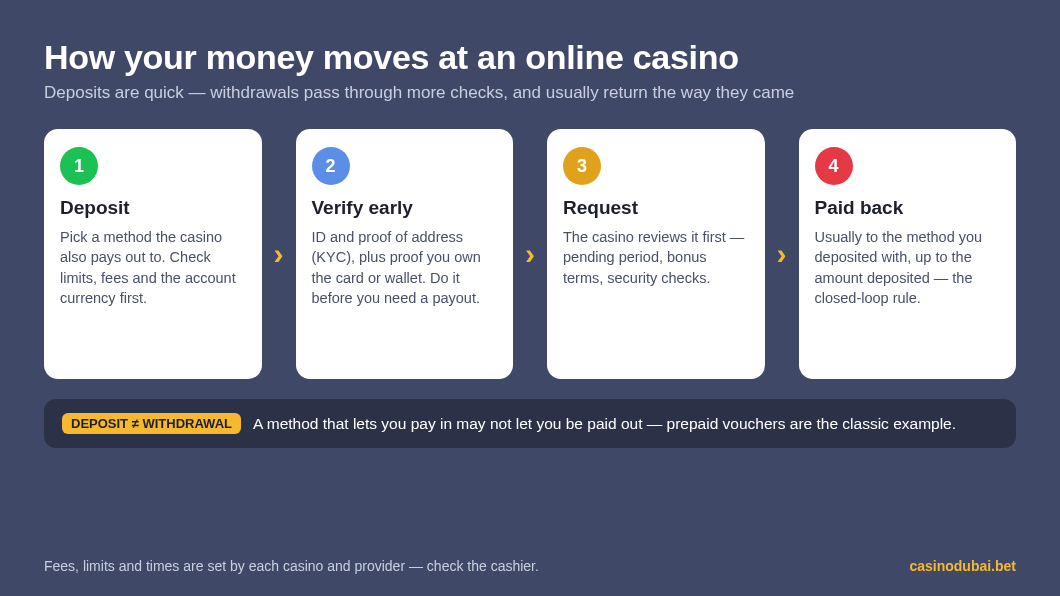
A method that supports deposits may not support withdrawals. This is the most common surprise at the cashier. Prepaid vouchers are the clearest example, and some operators accept card deposits without paying out to cards.
Most casinos also apply a closed-loop rule: winnings go back to the method you deposited with, up to the amount deposited, before anything else. The rule exists to prevent money laundering, and it means your choice of deposit method largely decides your withdrawal options. If you deposit with a voucher, you will be asked to add a method that can receive money — and to verify it — before you can be paid.
The Closed-Loop Rule, Worked Through
The closed-loop rule decides where your money goes when you withdraw, and it surprises players who used more than one method. Take an account funded with AED 500 by card and AED 300 by e-wallet, with a balance of AED 2,000 after some wins.
| Step | Where the money goes | Amount |
|---|---|---|
| 1 | Back to the card, up to what was deposited by card (if the casino pays to cards) | AED 500 |
| 2 | Back to the e-wallet, up to what was deposited by e-wallet | AED 300 |
| 3 | The remaining winnings, to a method of your choice that can receive payments — often the e-wallet or a bank transfer | AED 1,200 |
A typical order; each casino sets its own rules in its payment terms.
Three consequences follow. You may receive one withdrawal in several parts, through different methods and on different days. A method that cannot receive payments — a voucher, or a card the casino does not pay to — is skipped, and you will be asked to add and verify another. And the fewer methods you use, the simpler withdrawals are: one deposit method that can also receive winnings is the cleanest set-up.
What Happens Behind a Casino Payment
A casino rarely handles your money directly. Between you and the operator sit one or more payment service providers — companies that process card payments, run wallets or move bank transfers on the casino’s behalf — and, for cards, an acquiring bank that holds the merchant account. This explains several things players notice:
- A different name on your statement. The descriptor is often the provider’s or a company name, not the casino brand.
- Different methods on different days. Casinos switch providers, and a method available last month may be gone or routed differently today.
- A payment approved by the casino but not by your bank. The casino, the provider and your bank each make their own decision.
- Your card number not being stored by the casino. Reputable providers hold card data under the card industry’s PCI DSS security standard and give the casino only a token.
It also explains why the GCGRA’s warning to payment processors matters. Every unlicensed operator depends on providers willing to move its money; the authority has said those providers risk sanctions, which is one reason payment routes to unlicensed sites can disappear without notice.
Casino Payment Fees, Limits and Processing Times
Fees
Three parties can charge you: the casino (some charge for withdrawals, or for withdrawing before you have wagered your deposit), the payment provider (wallet fees, bank charges, crypto network fees) and the currency conversion between AED and the account currency. The conversion margin is the one most often missed, because it is built into the rate rather than shown as a fee.
Limits
Every method has a minimum and maximum deposit and a minimum and maximum withdrawal, and casinos often add weekly or monthly withdrawal caps. Large wins above a cap can be paid in instalments. Check the limits for your method before you deposit, not after you win.
Processing Times
Deposits are usually instant or close to it. Withdrawals have two stages: the casino’s own pending and review period, and then the time the provider or bank takes to move the money. A delay is more often caused by the first stage — incomplete verification, a bonus still being wagered, a security review — than by the payment method itself.
Currency Conversion: AED, USD and EUR
Many international casinos hold UAE accounts in US dollars or euros, so conversion costs can apply twice — on the way in and on the way out.
The dirham is pegged to the US dollar at AED 3.6725, so dollar amounts are easy to check: a $100 deposit is AED 367.25 at the peg. What your bank actually charges is the peg plus its foreign-currency margin and any fee, which is why a deposit of exactly the dollar minimum can arrive just below it. With euros there is no peg, and the dirham value of a euro balance moves every day.
Casinos With Dirham Accounts
A few international casinos let you hold your balance in AED. If yours does, deposits and withdrawals in dirhams avoid the casino-side conversion entirely, and every limit in the terms — minimum deposit, maximum bet, withdrawal cap — is shown in the currency you think in. Check two things: that the AED account is available for the payment method you plan to use, since some methods still settle in USD or EUR behind the scenes, and that the account currency is chosen before your first deposit, because many casinos fix it from then on.
Dynamic Currency Conversion
Some payment pages offer to charge your card in dirhams instead of the account currency. This is dynamic currency conversion: the conversion is done by the merchant’s provider, at a rate it chooses, rather than by your bank. The rate offered is often less favourable than your bank’s. If you are given the choice, compare both before confirming.
A Worked Example
You deposit AED 1,000 into a USD account. At the peg that is $272.29, but after a 2% conversion margin from your bank the casino receives about $266.85. If you later withdraw $266.85 back to the same card, the bank converts it again, with its margin, and you receive about AED 960 — some AED 40 less, without a single bet placed. The 2% margin is an illustration; check your own bank’s rate. The fewer times your money changes currency, the less this costs: an account in the currency you deposit in, or a method that holds that currency, avoids most of it.
The Withdrawal Timeline, Stage by Stage
A withdrawal passes through several hands, and knowing the stages tells you where to ask when it is late.
- Request. You choose the amount and method in the cashier. Any active bonus is checked first.
- Pending period. Many casinos hold requests for a set time, during which you can often cancel. If you do not want to be tempted to reverse a withdrawal, look for a setting that turns this option off.
- Review. The casino checks your verification, the payment method, and — if a bonus was involved — that its terms were met. This is where most delays happen.
- Approval and sending. The casino sends the payment to the provider: the card network, the wallet, the bank or the blockchain.
- Arrival. The provider or your bank credits your account. Bank transfers and card refunds take longest here; e-wallets and crypto are usually quickest.
If a withdrawal is late, the stage tells you who to ask: anything before “sending” is the casino’s; anything after is the provider’s or your bank’s. Ask the casino for the date and reference of the payment before you contact your bank.
Withdrawal Limits, Worked Through
Withdrawal caps matter most at the moment you least expect: after a big win. Suppose a casino caps withdrawals at $5,000 a week — about AED 18,360 at the peg — and you win AED 60,000.
| Week | Paid out | Still on account |
|---|---|---|
| 1 | About AED 18,360 | About AED 41,640 |
| 2 | About AED 18,360 | About AED 23,280 |
| 3 | About AED 18,360 | About AED 4,920 |
| 4 | About AED 4,920 | Nil |
Illustrative figures; each casino sets its own caps, and some apply monthly rather than weekly limits.
While the balance waits, it stays in your casino account — available to play, which is exactly the risk. Some casinos raise caps for VIP players, and progressive jackpot wins are often exempt from them; check the payment terms for both before you play for large amounts. If you want to protect a large win, request each instalment as soon as it becomes available and ask whether the casino can lock the remaining balance from play.
Large Withdrawals and Source-of-Funds Checks
Above certain amounts, or when your deposits rise sharply, a casino may ask for more than ID and proof of address. Anti-money-laundering rules require licensed operators to understand where a customer’s money comes from, and a large withdrawal is a common trigger.
- Source of funds — where the money you deposited came from: recent payslips or bank statements, for example.
- Source of wealth — for larger amounts, how you built your overall funds: employment, a business, a property sale or an inheritance.
- Payment proof — statements showing the deposits leaving your own account.
These checks are a sign the operator follows anti-money-laundering rules, not that you are suspected of anything. Answer them fully and promptly, send documents only through the casino’s secure upload, and keep copies of what you sent. A withdrawal under review for source of funds will not move until the review is closed.
When a Payment Is Declined or a Withdrawal Is Delayed
Most payment problems have an ordinary cause, and the fix is usually in your account rather than in the payment method.
If a Deposit Is Declined
- Check the message. “Declined by issuer” means your bank refused it; a casino error usually means a limit, a currency mismatch or an incomplete profile.
- Accept a bank refusal. If your bank blocks gambling payments, that is its decision. Do not retry with another person’s card or account — the casino will not pay winnings to a method that is not in your name, and using someone else’s payment details can be treated as fraud.
- Check you are not charged twice. A failed card payment can show as a pending authorisation for a few days before it disappears; ask your bank, not the casino, if it does not.
If a Withdrawal Is Delayed
- Verification. The most common cause is an identity or payment check that is still open. Look in your account for requested documents.
- Pending period. Many casinos hold withdrawals for a set review period, during which you can often cancel the request — check the cashier.
- Bonus terms. Winnings from an active bonus cannot usually be withdrawn until its wagering requirement is met.
- Name or method mismatch. Payouts go to accounts in your name, normally to the method you deposited with.
- Ask for a written reason. Contact support, keep the reference numbers and screenshots, and ask the casino to state in writing why the payment is held.
If the casino does not resolve it, your options depend on who licensed it: a complaint goes to that regulator, under its rules. With an unlicensed operator there is no regulator to turn to — which is the GCGRA’s central warning about playing with one.
Payment Problems: Causes and Fixes
| What you see | Most likely cause | What to do |
|---|---|---|
| Card deposit “declined by issuer” | Your bank blocks gambling transactions | Accept it; do not retry with someone else’s card |
| Deposit “failed” but money left your account | A pending authorisation that will be released | Wait a few days; ask your bank if it stays |
| Deposit below the bonus minimum | Conversion or fees reduced the amount received | Deposit slightly above the minimum next time |
| Withdrawal stuck in “pending” | The casino’s review period | Check the stated period; ask support after it ends |
| Withdrawal “on hold” | Open verification, or a source-of-funds check | Look for document requests in your account |
| Withdrawal rejected | Method not in your name, or bonus terms not met | Ask for the clause in writing; add a verified method |
| Fewer withdrawal options than deposit options | Closed-loop rule or method limitations | Use a method that can receive payments |
| Withdrawal split into several payments | Closed-loop rule across several deposit methods | Check each method for its part |
| Bank transfer arrived short | Intermediary bank fees or conversion | Ask your bank for the incoming payment details |
| Crypto deposit not credited | Waiting for confirmations, or a missing tag | Check the transaction on a blockchain explorer, then contact support with the transaction ID |
Questions to Ask Support About Payments
If the payment terms leave anything unclear, ask before your first deposit and keep the answers in writing:
- Which methods can a UAE account use for withdrawals, not only for deposits?
- In which currency will my account be held, and can it be changed?
- Are there fees on deposits or withdrawals for my method?
- What are the withdrawal limits per transaction, per week and per month?
- How long is the pending period, and can I turn off the option to reverse withdrawals?
- Which documents will you need before my first withdrawal?
- Do you charge an inactivity fee, and after how long?
Clear, consistent answers are a good sign. Vague ones — or answers that contradict the published terms — are worth weighing before you deposit.
Chargebacks and Payment Disputes
A chargeback is a request to your card issuer to reverse a payment. It exists for fraud and for goods or services that were not delivered — not for gambling losses. Asking your bank to reverse deposits you made and lost is likely to be refused, and the casino will usually close the account and may pursue the amount.
There are legitimate cases: a payment you did not make, a deposit charged twice, or a deposit that never reached your casino balance. In those cases, contact the casino first with the transaction details; if it does not resolve the problem, your bank can open a dispute. For payments made by e-wallet, the wallet provider has its own dispute process. Crypto transfers cannot be reversed at all, which is why crypto payments to an unknown or unlicensed site carry the highest risk.
Payment Scams to Avoid
Gambling attracts scams that look like payment problems. These are the patterns most often reported:
- “Pay a fee to release your winnings.” A site or “agent” tells you a tax, verification fee or unlocking fee must be paid before a withdrawal. Genuine casinos deduct any fee from the withdrawal itself; a demand for a new deposit to release money is a hallmark of fraud.
- Agents who take payment on a messaging app. Someone on WhatsApp or Telegram offers to top up your casino account in exchange for a bank transfer or cash. You have no protection, no record the casino will recognise, and no way to get the money back.
- Payments to personal accounts. A cashier that asks you to transfer money to an individual’s bank account or wallet, rather than through a recognised provider, is not a legitimate cashier.
- Fake support. Messages claiming to be from your casino’s support asking for your password, one-time code or card details. Real support will never ask for these.
- Copycat sites. Lookalike domains with a familiar logo, reached from an advert or a message. Type the address yourself or use a bookmark.
- Recovery scams. After a loss, someone offers to recover your money for an upfront fee. They are usually the same people, or people who bought the list of victims.
If you have been targeted, stop paying, keep every message and transaction record, and report it to your bank and to the police — in the UAE, financial fraud can be reported through the police’s official channels, including the Dubai Police eCrime platform.
What to Check in the Cashier Before Your First Deposit
Five minutes in the cashier and the payment terms before you deposit prevent most problems later:
- Account currency — and whether it can be changed after the first deposit (often it cannot).
- Withdrawal methods — open the withdrawal tab, not just the deposit tab, and see what is listed for your account.
- Minimum and maximum withdrawal per transaction, and any daily, weekly or monthly cap.
- Withdrawal fees — including fees for withdrawing before your deposit has been wagered once, which some casinos charge.
- Pending period — how long requests are held, and whether you can turn off the option to cancel them.
- Verification requirements — what documents are needed before the first payout.
- Inactivity rules — whether a dormant account is charged a fee after a period without play.
If the cashier does not show withdrawal options until you have deposited, ask support in writing which methods will be available for withdrawals from a UAE account before you deposit anything.
Paying From a Bank Account Abroad
Many UAE residents keep bank accounts and cards in their home country, and some use them to pay at casinos. It is worth knowing how a casino sees that. Your account address is in the UAE, but your card or bank is in another country, and that mismatch is a common trigger for extra checks. The bank’s own country also matters: gambling payments may be blocked, restricted or taxed differently there, and the casino’s terms may not allow players to use payment methods from countries where it does not operate. Whatever card or account you use, it must be in your name, and expect to prove it at verification. Do not register with a home-country address you no longer live at to match a card — that is a false declaration, and it is the kind of mismatch that freezes withdrawals.
How to Verify a Payment Method
Most casinos ask you to prove that each payment method is yours before your first withdrawal to it. The usual evidence:
- Card — a photo of the front showing your name, the first six and last four digits and the expiry date, with the middle digits and the CVV on the back covered.
- E-wallet — a screenshot of the wallet’s account page showing your name and the email or account ID.
- Bank account — a recent statement or a screenshot from your banking app showing your name and IBAN.
- Crypto — sometimes a screenshot of the exchange account the withdrawal address belongs to.
Upload these through the casino’s secure document page, never by email or chat unless the casino directs you to, and do it as soon as you add a method rather than when you ask for a payout.
Using More Than One Payment Method
Adding methods to one account is allowed at most casinos, but each new method adds a verification step and a leg to the closed loop. Every method must be in your name; a card or wallet belonging to a family member is treated as a third-party payment, and winnings will not be paid to it. If a deposit method stops working — a card expires or a wallet is closed — tell support before you request a withdrawal, so they can approve an alternative instead of returning the payment.
Account Security and Your Payments
Most payment losses at casinos come from account takeovers rather than from the payment systems themselves. Use a unique password for your casino account and a separate, secured email address; turn on two-step verification if it is offered; and never save card details on a shared device. If a casino lets you lock withdrawals to verified methods only, use it: anyone who gains access to your account then cannot redirect your winnings.
Inactive Accounts, Closed Accounts and Your Balance
Money left in a casino account is still your money, but terms decide how long it stays untouched. Many casinos charge an inactivity fee after a long period without logging in or playing, deducted from your balance each month. If you close an account, withdraw your balance first: closing usually ends any active bonus and can delay a payout until the account is reviewed. If a casino closes your account, ask for the balance to be paid out and for the reason in writing. And if a casino stops operating altogether, your ability to recover a balance depends on its licence — another reason to withdraw winnings rather than leave them on account.
What the Casino Sees and Keeps About Your Payments
When you pay, a casino learns more about you than your name. It records each method you use, the amounts and times of every transaction, the device and IP address you used, and the documents you uploaded. Licensed operators are required to keep many of these records for years under anti-money-laundering rules — five years after the relationship ends is a common requirement — so closing an account does not erase them. A licensed operator must also protect that data under the privacy law of its licence; an unlicensed one offers no such assurance, which is a reason to think twice before uploading an Emirates ID or a bank statement to a site you cannot verify. Read the privacy notice for what is shared with payment providers and other group companies, and use the account settings to opt out of marketing.
A Monthly Budget, Worked Through
Payment tools make a budget concrete. Suppose you decide that AED 800 a month is the most you are willing to lose on casino games.
| Setting | Value | Why |
|---|---|---|
| Monthly deposit limit | AED 800 | The casino blocks any deposit beyond it |
| Weekly deposit limit | AED 200 | Stops the whole month’s budget going in one evening |
| Payment methods | One debit card or one e-wallet | No second route when the limit is reached |
| Withdrawal rule | Withdraw any balance above AED 400 | Winnings leave the account instead of being played again |
| Monthly check | Bank statement total | Confirms the real figure, including fees and conversion |
An example to show the method; the right figures are whatever you can afford to lose without affecting anything else.
The point is to decide before you play, when the decision is easy, and let the settings hold it for you later. Lowering a deposit limit takes effect immediately at most casinos; raising it usually takes a cooling-off period, which is exactly what makes it useful.
Keeping Records of Casino Payments
A short record of your payments makes any problem easier to solve and helps you see what you are really spending. For each deposit and withdrawal, keep the date, amount, method, casino reference and the amount that reached or left your bank. Screenshot the cashier’s transaction history from time to time, since casinos are not obliged to keep it visible indefinitely. Your bank statements show the other side: totting up a month of gambling transactions there is one of the clearest ways to check that play is staying within your budget.
Red Flags in Payment Terms
Most casinos’ payment terms are strict but fair. These are the ones that suggest a casino will be difficult when you want your money:
- A fee on every withdrawal, rather than only on specific methods or early withdrawals.
- Very low withdrawal caps — a weekly limit that would take months to pay out a moderate win.
- A requirement to wager your own deposit several times before you can withdraw it, with no bonus involved.
- Payout “at the casino’s discretion” — clauses that let the operator choose when, how or in what instalments to pay without stated limits.
- Long or open-ended pending periods, combined with an easy button to reverse your withdrawal.
- Withdrawals only by a method you did not deposit with, or only in crypto, when you deposited by card.
- Inactivity fees after a short period, or fees that can take the whole balance.
- Payment terms missing altogether, or available only after you deposit.
Any one of these is worth a question to support before you deposit; several together are a reason to choose another operator. And remember that no set of payment terms answers the legal question: only the GCGRA’s register shows which operators may offer gambling in the UAE.
How to Choose a Casino Payment Method
- Availability — offered by your casino, from the UAE, for the currency you use.
- Withdrawal support — the deciding factor; check it first.
- Deposit speed — instant for most methods except bank transfer.
- Fees — from the casino, the provider and the currency conversion combined.
- Limits — high enough for how you play, and for what you might win.
- Currency — an AED account, or a method that converts at a fair rate.
- Security — strong authentication and no need to share card details where avoidable.
- Verification — what documents the method will need at payout.
- Convenience — works smoothly on your phone, without workarounds.

Payment Methods by Type of Player
| If you… | Methods that tend to suit you | Watch out for |
|---|---|---|
| Want to keep to a strict budget | Prepaid vouchers, a debit card with a deposit limit | Vouchers cannot receive winnings — set up a withdrawal method early |
| Want fast payouts | E-wallets or crypto, where the casino supports them for withdrawals | Wallet fees and bonus exclusions; irreversible crypto transfers |
| Play with larger amounts | Bank transfer for withdrawals | Withdrawal caps, source-of-funds checks, intermediary fees |
| Prefer not to share bank details | E-wallets, digital wallets, vouchers | The wallet itself still verifies your identity |
| Mainly play on a phone | Apple Pay or Google Pay where offered, e-wallet apps | Digital wallets follow your card’s rules |
| Want the simplest withdrawals | One method that both deposits and receives | Multiple methods split withdrawals under the closed-loop rule |
Bonuses and Payment Methods
The method you deposit with can change what a bonus is worth — or whether you get it at all.
- Excluded methods. Some casinos exclude deposits made with e-wallets or prepaid vouchers from welcome bonuses. The list is in the bonus terms, not the cashier.
- Minimum qualifying deposit. A bonus usually needs a minimum deposit, which can be higher than the method’s own minimum.
- Wagering before withdrawal. Accepting a bonus normally locks the bonus and its winnings until a wagering requirement is met. If you expect to withdraw soon, consider playing without one.
- Maximum withdrawal from bonus winnings. Some offers cap how much can be withdrawn from bonus play, whatever you win.
- Method-specific offers. Crypto-only bonuses can come with different wagering terms from the standard welcome offer — read them separately.
Are Online Casino Payments Safe?
The payment is as safe as the operator and the provider behind it. Check that:
- the cashier runs over an encrypted HTTPS connection and card payments use your bank’s own authentication (such as 3-D Secure);
- the payment is handled by a recognised provider, not by a link to an unknown site or a request to send money to a personal account;
- you complete identity verification (KYC) — passport or ID and proof of address — which licensed operators require under anti-money-laundering rules;
- you may be asked for payment verification, such as a photo of your card with the middle digits covered or a screenshot of your e-wallet account;
- you never share your card PIN, one-time codes or wallet passwords with anyone.
Licensing matters here too. The GCGRA has warned that payment processors and other service providers that support unlicensed operators risk sanctions, and a casino without proper oversight has no obligation to keep player funds safe or pay out at all.
Casino Payment Methods for UAE Players
For players in the UAE, four things are different:
- Availability varies by operator. International casinos decide which methods they offer to UAE accounts, and some well-known methods are missing.
- Banks may decline gambling transactions. Card payments to casinos carry a gambling code that many banks block. A declined payment is your bank’s decision; an approved one is not a sign that the casino is licensed.
- Currency affects the cost. Many casinos hold accounts in USD or EUR, so every AED deposit and withdrawal is converted.
- Withdrawal support needs checking for every method, before the first deposit.
Keep the payment question separate from the legal one. Only operators licensed by the GCGRA may offer gambling in the UAE — currently Play971 for online casino and sports betting — and the authority has reported blocking more than 6,500 illegal gambling websites since it was set up. We do not explain ways around bank blocks or website blocks — and using a VPN to hide your location in order to commit an offence is itself punishable under the UAE’s cybercrime law (Federal Decree-Law No. 34 of 2021, Article 10). Read our UAE gambling laws guide before you deposit anywhere.
Licensed vs Unlicensed Operators: What Changes for Your Money
The licence behind a casino matters more for your payments than any single payment method. A regulated operator is typically required to verify customers, follow anti-money-laundering rules, publish its terms, offer a complaints process and, under several regulators, keep customer funds protected or separate from its operating money. If a payout is refused, there is a regulator to complain to.
With an unlicensed operator none of that is guaranteed. There may be no complaints route, no obligation to pay, and no authority with power over the business. That is the core of the GCGRA’s warnings: it has said that unlicensed operators offer no player protection and that payment processors supporting them risk sanctions. A casino licensed abroad sits between the two — it answers to its own regulator, but not to any UAE authority.
What Your Bank Sees
UAE banks are required under the country’s anti-money-laundering law to monitor customer transactions, and payments to and from gambling businesses stand out. Depending on the bank, that can mean a declined card payment, a call or message asking about a transaction, or questions about an incoming transfer from abroad. Answer honestly; never describe a payment as something it is not, which can turn a routine question into a serious problem. If your bank declines gambling payments, it is applying its own policy — and the decision about whether that policy is right for you is not one a casino can override.
How We Evaluate Casino Payments
When we rate a casino’s payments, we look at what a player in the UAE will actually experience, not at the number of logos in the footer:
- Withdrawal options for a UAE account, not just deposit options.
- Clarity of the payment terms — limits, fees, pending period and closed-loop rules stated in one findable place.
- Fees charged by the casino on deposits and withdrawals, including early-withdrawal fees.
- Withdrawal limits per transaction and per period, and how large wins are paid.
- Account currencies available, and how conversion is handled.
- Verification — what is required, and whether it can be completed before the first payout request.
- Security — strong authentication, recognised providers and protection against account takeover.
- Licensing — where the operator is licensed, stated plainly as not UAE authorisation unless it is the GCGRA.
Casino Payments on Mobile
Most deposits are now made on a phone. A good mobile cashier works fully in the browser or app, lets you upload verification documents from the camera, and supports digital wallets such as Apple Pay and Google Pay where the operator offers them — which pay with a stored card, so your bank’s rules still apply. Mobile banking apps make bank-transfer withdrawals easier to track. For what to look for in a casino app and how app and browser compare, see our casino apps guide.
A few habits make mobile payments safer. Approve card payments in your bank’s own app rather than by text message where you can, so you see the amount and the merchant before confirming. Use your phone’s biometric lock for the casino app or browser, so someone who picks up an unlocked phone cannot deposit. Avoid making payments on public Wi-Fi without a trusted connection, and upload verification documents through the casino’s secure upload rather than by email from your phone. Finally, turn off promotional notifications if they tempt you to deposit — mobile is where impulse deposits happen most.
When the Casino Asks You to Change Method
Sometimes a casino asks you to withdraw by a different method from the one you deposited with — because the original method cannot receive payments, has expired, or has been withdrawn by the provider. This is normal, but treat it carefully. The new method must be in your name and verified, and the request should come through your account or official support, not through a message asking you to send details elsewhere. If you are asked to pay to “activate” a new withdrawal method, stop: that is a scam pattern, not a casino procedure.
Play Responsibly
Payment tools are also your best limits. Set a deposit limit in the cashier before you start, avoid credit cards for gambling, and never deposit money you need for anything else. If you find yourself reaching for a second method after the first is declined, treat it as a reason to stop.
Payment settings are some of the most effective controls you have, because they act before you play:
- Deposit limits in the casino’s cashier, per day, week or month. Lowering a limit takes effect at once; raising it usually takes a waiting period.
- One payment method — fewer methods mean fewer ways to deposit on impulse.
- No saved card details, so every deposit takes a deliberate step.
- Withdrawal locks, where available, so a withdrawal cannot be reversed and played again.
- A monthly look at your bank statement, totalling what went to gambling.
Confidential support is available at BeGambleAware.

Casino Payments Glossary
| Term | What it means |
|---|---|
| Cashier | The section of a casino account where you deposit, withdraw and see your transaction history. |
| Closed-loop rule | Withdrawals go back to the deposit method first, up to the amount deposited with it. |
| Pending period | The time a withdrawal request waits before the casino processes it, during which it can often be cancelled. |
| Withdrawal cap | The most that can be withdrawn per transaction, day, week or month. |
| KYC | “Know your customer” — identity and address checks required before payouts. |
| Source of funds | Evidence of where the money you deposited came from. |
| Source of wealth | Evidence of how your overall funds were built, asked for larger amounts. |
| MCC 7995 | The merchant category code used for gambling card payments, which many banks block. |
| 3-D Secure | Your bank’s extra approval step for online card payments. |
| Cash advance | How a bank may treat a credit card gambling payment, with a fee and immediate interest. |
| Chargeback | A reversal of a card payment by the issuer, for fraud or non-delivery — not for gambling losses. |
| Dynamic currency conversion | Conversion done by the merchant’s provider at the point of payment, often at a worse rate than your bank’s. |
| Currency peg | The fixed rate of AED 3.6725 to the US dollar. |
| IBAN | International bank account number; UAE IBANs have 23 characters and start with “AE”. |
| SWIFT/BIC | The code identifying a bank in international transfers. |
| Intermediary bank | A bank between sender and receiver in an international transfer, which may deduct a fee. |
| Network (crypto) | The blockchain a coin is sent on, such as TRC-20 or ERC-20 for USDT. |
| Memo / destination tag | An extra identifier some coins need to credit the right account. |
| Confirmation | A block added after a crypto transaction; casinos credit deposits after a set number. |
| Stablecoin | A crypto token designed to hold a fixed value, usually one US dollar. |
| Custodial wallet | A crypto wallet whose keys are held by a provider, such as an exchange. |
| Inactivity fee | A charge some casinos deduct from dormant accounts. |
FAQ
- What are the best online casino payment methods?
The one your casino supports for both deposits and withdrawals, at fees and speeds you accept. E-wallets are often quick where offered; bank transfers suit large withdrawals; vouchers suit tight budgets but cannot usually receive winnings.
- Which casino payment methods are available in the UAE?
It depends on the operator. Cards, e-wallets and crypto are commonly offered by international casinos, but each sets its own list for UAE accounts, and banks may decline gambling payments.
- Can I withdraw using the same method I used to deposit?
Usually you must — casinos commonly return funds to the deposit method first. If that method cannot receive payments, the casino will ask you to add and verify another.
- How long do casino withdrawals take?
It depends on the casino’s review period, your verification status and the method. Delays most often come from incomplete KYC or an active bonus, not the payment itself.
- Are online casino payments safe?
With a licensed operator, a recognised provider and an encrypted cashier, the payment itself is secure. The bigger risk is the operator: an unlicensed casino has no obligation to pay out.
- Do casino payment methods charge fees?
They can — the casino, the payment provider and the currency conversion may each add a cost. Check all three before you deposit.
- Can I use Visa or Mastercard at online casinos?
Many casinos accept them for deposits, but your bank may decline gambling transactions, and withdrawals to a card are not always offered.
- Why was my casino withdrawal delayed?
Usually an open verification check, the casino’s pending period, an active bonus still being wagered, or a payout method that is not in your name. Ask support for the reason in writing.
- Can I use KNET at an online casino in the UAE?
KNET is Kuwait’s national payment network and works with Kuwaiti bank cards. Cards issued by UAE banks do not use it.
- Is crypto a good way to pay at an online casino?
It can be quick where a casino supports it for withdrawals, but transfers are irreversible, prices move, and a wrong network or missing tag can lose funds. The UAE Central Bank also restricts which tokens may be used as a means of payment.
- Which network should I use for USDT?
The one the casino’s deposit page specifies for that address. USDT exists on several networks, and sending it on the wrong one can mean the funds are lost.
- Can I use PayPal at online casinos?
Rarely. PayPal allows gambling payments only with its prior approval and only where gambling is legal for both the operator and the customer.
- Can I use Apple Pay or Google Pay?
Where a casino offers them. They pay with the card stored in your phone, so your bank’s rules on gambling payments still apply, and withdrawals usually go back to that card.
- Why did my withdrawal arrive in several payments?
Usually because of the closed-loop rule: each deposit method is repaid up to what it deposited, and the rest goes to a method of your choice. A withdrawal cap can also split a large amount.
- Do I need to verify my payment method?
Usually yes, before the first withdrawal to it — a covered card photo, a wallet screenshot or a bank statement showing your name.
- Can I use a family member's card?
No. Payments must be made with methods in your own name. Winnings will not be paid to someone else’s card, and using one can lead to the account being closed.
- Why do I lose money on currency conversion?
If your account is in USD or EUR, your bank converts each AED deposit and withdrawal at its own rate plus a margin. Converting twice — in and out — doubles the cost.
- Can I reverse a casino deposit with my bank?
Only for genuine problems such as fraud or a payment that never reached your balance. Chargebacks for gambling losses are usually refused and can lead to the account being closed.
- What should I do if someone asks me to pay a fee to release my winnings?
Stop paying. Genuine casinos deduct any fees from the withdrawal itself. A demand for a new payment to release winnings is a common scam — keep the records and report it to your bank and the police.
- Is there a limit on how much I can withdraw?
Almost always — per transaction and per day, week or month. Large wins above a cap are paid in instalments; check the limits before you play for large amounts.
- Can I hold my casino balance in dirhams?
At a few casinos. Most hold UAE accounts in USD or EUR. If an AED account is offered, choose it before your first deposit, as the currency is often fixed after that.
- Why does my statement show a different company name?
Casinos use payment service providers, and the descriptor on your statement is often the provider’s or a company name. Ask the casino to confirm it if you are unsure, and your bank if the casino cannot.
- Is it safe to upload my Emirates ID to a casino?
Only to an operator whose licence you have checked, through its secure document upload. Licensed operators must protect that data; an unlicensed site gives no such assurance.
- Should I send a test amount with crypto?
Yes, the first time you use a casino or a network — a small amount above the minimum confirms the address, network and tag before you send more.
- What is the safest way to deposit?
A method in your name with strong authentication — a debit card with 3-D Secure, a digital wallet or a verified e-wallet — at an operator whose licence you have checked. The operator matters more than the method.
- Can I cancel a withdrawal?
At many casinos, yes, while it is still in the pending period — the money returns to your balance. That convenience is also a risk, because returned money is easy to play again. If the casino lets you turn off withdrawal reversal, consider doing so; once a withdrawal has been sent, it can no longer be cancelled.
- Does the casino or my bank decide if a payment goes through?
Both, separately. The casino and its payment provider decide whether to accept the payment; your bank decides whether to authorise it. Either one can stop it, and neither decision says anything about whether the operator is licensed in the UAE.