
Poker: Hand Rankings, Rules, Odds and UAE Legal Status
Poker is the card game in which players bet on who holds the best five-card hand. In classic poker you play against other players, not the house: the room takes a small cut of each pot, the rake, and skill decides who wins over time.
Casino versions such as Casino Hold’em and Three Card Poker are played against the dealer instead, with a house edge of about 2% to 3.5%. In the UAE, gambling is legal only with operators licensed by the GCGRA — and the only licensed online casino, Play971, had no live poker tables in its lobby when we checked it on 22 October 2026.
This guide explains the poker hand rankings with the real odds of each hand, how a round of Texas Hold’em works, the betting rules beginners ask about, the numbers behind starting hands and draws — calculated by us — the main variants, the casino poker games and their house edge, and where poker stands legally in Dubai and the rest of the UAE. Last reviewed: 22 October 2026.
Best Online Casinos for Poker in Dubai in 2026
These are the casinos we rate. Which poker games each one offers — casino poker against the dealer, video poker or player-vs-player tables — varies by operator, so check the lobby and each game’s rules before you play. Play971, at the top, is the only one licensed by the UAE’s GCGRA; the others are licensed abroad. See the poker hand rankings and their odds before you choose.






Poker at a Glance
| Item | Details |
|---|---|
| Aim | Win the pot — with the best five-card hand at showdown, or by making everyone else fold |
| Deck | 52 cards, no jokers |
| Most popular variant | Texas Hold’em: two private cards each, five shared cards |
| Who you play against | Other players (poker rooms) or the dealer (casino poker games) |
| How the operator earns | A rake from each pot, or a house edge in casino versions |
| Rarest hand | Royal flush — 1 in 649,740 five-card hands |
| Most common result | No pair (high card) in five cards; one pair in seven |
| Licensed online in the UAE | Play971, the only GCGRA-licensed online casino |
| Minimum age at Play971 | 21, and you must be physically in the UAE |
Poker Hand Rankings
Every standard poker game uses the same ten hands, from strongest to weakest. A hand is always five cards; in games with more cards, such as Texas Hold’em, you use the best five you can make. Suits are never ranked against each other — a flush in hearts and a flush in spades are compared by their highest cards.
| Rank | Hand | Example | What it means |
|---|---|---|---|
| 1 | Royal flush | A♠ K♠ Q♠ J♠ 10♠ | Ace-high straight, all one suit |
| 2 | Straight flush | 9♥ 8♥ 7♥ 6♥ 5♥ | Five in sequence, all one suit |
| 3 | Four of a kind | Q♣ Q♦ Q♥ Q♠ 4♦ | Four cards of the same rank |
| 4 | Full house | 8♠ 8♦ 8♣ K♥ K♠ | Three of a kind plus a pair |
| 5 | Flush | A♦ J♦ 9♦ 6♦ 2♦ | Five cards of one suit, not in sequence |
| 6 | Straight | 10♣ 9♦ 8♠ 7♥ 6♣ | Five in sequence, mixed suits |
| 7 | Three of a kind | 7♠ 7♥ 7♦ K♣ 2♠ | Three cards of the same rank |
| 8 | Two pair | J♥ J♣ 4♠ 4♦ A♥ | Two different pairs |
| 9 | One pair | 10♥ 10♠ K♦ 7♣ 3♥ | Two cards of the same rank |
| 10 | High card | A♣ Q♦ 8♠ 5♥ 3♣ | None of the above; the highest card plays |
Two details settle most arguments at the table. The ace can be high (10-J-Q-K-A) or low (A-2-3-4-5, called a “wheel”), but a straight cannot wrap around (Q-K-A-2-3 is not a straight). And when two players have the same type of hand, the higher cards win: a pair of kings beats a pair of queens, and if both have the same pair, the highest unpaired card — the kicker — decides.
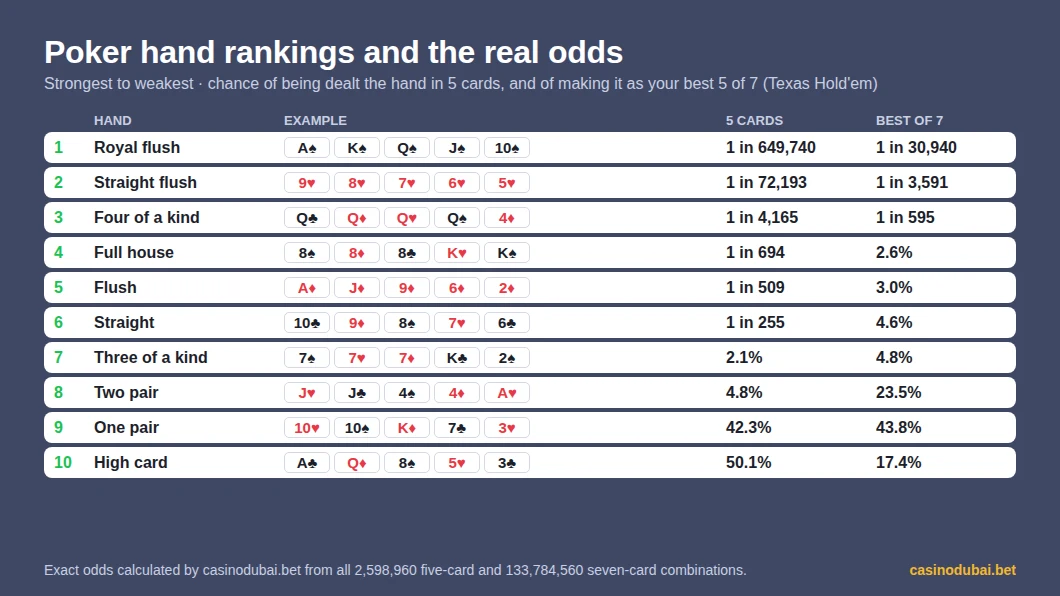
Poker Hand Odds: Five Cards and Seven Cards
The rankings follow the maths: the rarer a hand, the higher it ranks. We calculated the exact chance of each hand in two situations — being dealt five cards, as in five-card draw or video poker before the draw, and making it as your best five out of seven cards, as in Texas Hold’em with your two cards and the five on the board.
| Hand | Dealt in 5 cards | Best of 7 cards |
|---|---|---|
| Royal flush | 1 in 649,740 | 1 in 30,940 |
| Straight flush | 1 in 72,193 | 1 in 3,591 |
| Four of a kind | 1 in 4,165 | 1 in 595 |
| Full house | 1 in 694 | 2.6% (1 in 38) |
| Flush | 1 in 509 | 3.0% (1 in 33) |
| Straight | 1 in 255 | 4.6% (1 in 22) |
| Three of a kind | 2.1% (1 in 47) | 4.8% (1 in 21) |
| Two pair | 4.8% (1 in 21) | 23.5% |
| One pair | 42.3% | 43.8% |
| High card | 50.1% | 17.4% |
Our calculation, from the 2,598,960 possible five-card hands and the 133,784,560 possible seven-card combinations.
Two things stand out. With seven cards you make at least a pair more than 80% of the time, so a single pair is a much weaker holding in Texas Hold’em than in five-card games. And a flush is rarer than a straight in both cases — which is why it ranks higher.
How to Play Texas Hold’em
Texas Hold’em is the version played in almost every poker room, televised tournament and poker app. A table seats between two and ten players, and a button marks the nominal dealer, moving one seat clockwise after each hand.
01
Blinds. The two players to the left of the button post forced bets: the small blind and the big blind, usually twice as large. They make sure there is something to win in every hand.
02
Hole cards. Each player gets two cards face down, seen only by them.
03
Pre-flop betting. Starting left of the big blind, each player folds, calls the big blind or raises.
04
The flop. Three shared cards are dealt face up in the middle, followed by a second betting round, starting with the first active player left of the button.
05
The turn. A fourth shared card, and another betting round.
06
The river. The fifth and last shared card, and a final betting round.
07
Showdown. The remaining players show their cards. Each makes the best five-card hand from their two hole cards and the five on the board, using both, one or none of their own cards. The best hand wins the pot.
A hand can end at any point: if everyone else folds, the last player left wins the pot without showing their cards. That is what makes bluffing possible — and why poker is a game of decisions, not just of cards.
Betting Actions: Check, Bet, Call, Raise, Fold
| Action | When you can do it | What it means |
|---|---|---|
| Check | No one has bet in this round | Pass without betting, keeping your cards |
| Bet | No one has bet in this round | Put the first chips in for this round |
| Call | Someone has bet | Match the current bet |
| Raise | Someone has bet | Increase the bet; others must call the new amount to continue |
| Fold | Any time it is your turn | Give up your cards and any chips already in the pot |
| All-in | Any time it is your turn | Bet everything you have on the table |
A betting round ends when every player still in the hand has put in the same amount, or has gone all-in.
Betting Structures: No-Limit, Pot-Limit and Fixed-Limit
The same game plays very differently depending on how much you are allowed to bet:
| Structure | Maximum bet | Where you see it | What it feels like |
|---|---|---|---|
| No-Limit | Everything in front of you | Texas Hold’em, most tournaments | One hand can win or lose your whole stack |
| Pot-Limit | The size of the pot | Omaha | Big pots, but they build more gradually |
| Fixed-Limit | A set amount per round | Some Hold’em and Stud games | Slower swings; more hands go to showdown |
For a beginner the structure matters as much as the game. No-Limit is the most exciting and the most dangerous: a single mistake can cost an entire buy-in.
Poker Rules Players Ask About
Is poker played with five or seven cards? A poker hand is always five cards. Texas Hold’em gives you seven to choose from — two in your hand and five on the board — and Seven-Card Stud deals you seven of your own; in both you use the best five. Five-card draw and video poker deal exactly five.
What happens in a tie? The kicker decides when hands are otherwise equal. If the best five cards are identical — for example, when the board itself is the best hand for both players — the pot is split equally.
What if a player goes all-in for less? They can only win, from each opponent, as much as they put in. Any extra betting between the other players goes into a side pot that the all-in player cannot win.
Do I have to show my cards? Only at showdown, if you want to claim the pot. A player who wins because everyone else folded never has to show.
Can I bet more than I have on the table? No. In “table stakes” — the rule in almost every game — you can only bet the chips in front of you when the hand starts, and you cannot be forced out of a hand because an opponent bets more than you have.
Texas Hold’em Starting Hands: The Numbers
There are 1,326 possible two-card starting hands. A few numbers explain why patience is the first skill in Hold’em:
| Starting hand | How often you get it |
|---|---|
| Pocket aces (A-A) | 1 in 221 hands |
| Any pocket pair | 1 in 17 hands (5.9%) |
| Ace-king (A-K), suited or not | 1 in 83 hands |
| Two cards of the same suit | 23.5% of hands |
Even the best hand is never safe. We simulated 40,000 deals of each of these classic match-ups, all-in before the flop:
| Match-up | First hand wins | Tie | Second hand wins |
|---|---|---|---|
| A♠A♥ vs K♠K♥ | 82% | 1% | 17% |
| A♠K♦ vs Q♥Q♣ | 42% | 0.4% | 57% |
| A♥K♥ vs 2♠2♣ | 50% | 1% | 50% |
| A♠A♦ vs 7♥2♣ | 87% | 0.3% | 12% |
| J♥10♥ vs A♠A♦ | 22% | 0.4% | 78% |
Our Monte Carlo simulation, 22 October 2026; results within about half a percentage point.
The worst possible starting hand, 7-2 offsuit, still beats pocket aces about one time in eight. And a small pair against two big cards is close to a coin flip — the “race” that decides many tournaments.
Drawing Odds: Outs and the Rule of 4 and 2
An out is a card that would turn your hand into the likely winner. Count your outs after the flop, and you can estimate your chances quickly: multiply them by about 4 with two cards to come, or by about 2 with one card to come. The exact figures:
| Draw on the flop | Outs | Hit on the turn | Hit by the river | Rule of 4 estimate |
|---|---|---|---|---|
| Flush draw (four of a suit) | 9 | 19.1% | 35.0% | 36% |
| Open-ended straight draw (e.g. 8-9-10-J) | 8 | 17.0% | 31.5% | 32% |
| Gutshot straight draw (e.g. 8-9-J-Q) | 4 | 8.5% | 16.5% | 16% |
| Pocket pair to a set | 2 | 11.8% to flop three of a kind | — | |
Compare those chances with the price you are offered. If the pot is AED 300 and you must call AED 100, you are risking 100 to win 300 — you need to win more than one time in four (25%) for the call to pay in the long run. A flush draw with two cards to come (35%) clears that bar; a gutshot (16.5%) does not. That comparison, called pot odds, is the single most useful piece of poker maths.
Other Poker Variants
| Variant | Cards | How it differs from Hold’em |
|---|---|---|
| Omaha (Pot-Limit Omaha) | 4 private, 5 shared | You must use exactly two of your four cards and three from the board; hands run much stronger |
| Seven-Card Stud | 7 of your own, 4 face up | No shared cards; five betting rounds; you read opponents’ visible cards |
| Five-Card Draw | 5 private | One chance to swap cards; the classic home game |
| Short Deck (6+) | 2 private, 5 shared, 36-card deck | Twos to fives removed; a flush beats a full house because flushes become rarer |
| Razz and lowball games | Varies | The lowest hand wins |
For a beginner, Texas Hold’em is the place to start: it is the most widely played variant, and the hand rankings above apply to all of these games except Short Deck and lowball.
Casino Poker vs Player-vs-Player Poker
“Poker” in an online casino can mean two very different things, and the difference decides who you are really playing against.
| Item | Player-vs-player poker | Casino poker games |
|---|---|---|
| Opponent | Other players | The dealer (the house) |
| How the operator earns | Rake: a small share of each pot, usually capped, or a tournament fee | House edge built into the payouts |
| Can skill make you a long-term winner? | Yes, if you are better than your opponents by more than the rake | No — correct strategy only reduces the house edge |
| Bluffing | Central to the game | Impossible: the dealer follows fixed rules |
| Examples | Texas Hold’em cash games and tournaments, Omaha | Casino Hold’em, Ultimate Texas Hold’em, Three Card Poker, Caribbean Stud, video poker |
Skill in player-vs-player poker is real, but it is relative: you win only if you are better than the people at your table, after the rake. Most players do not beat the game over time.
Casino Poker Games and Their House Edge
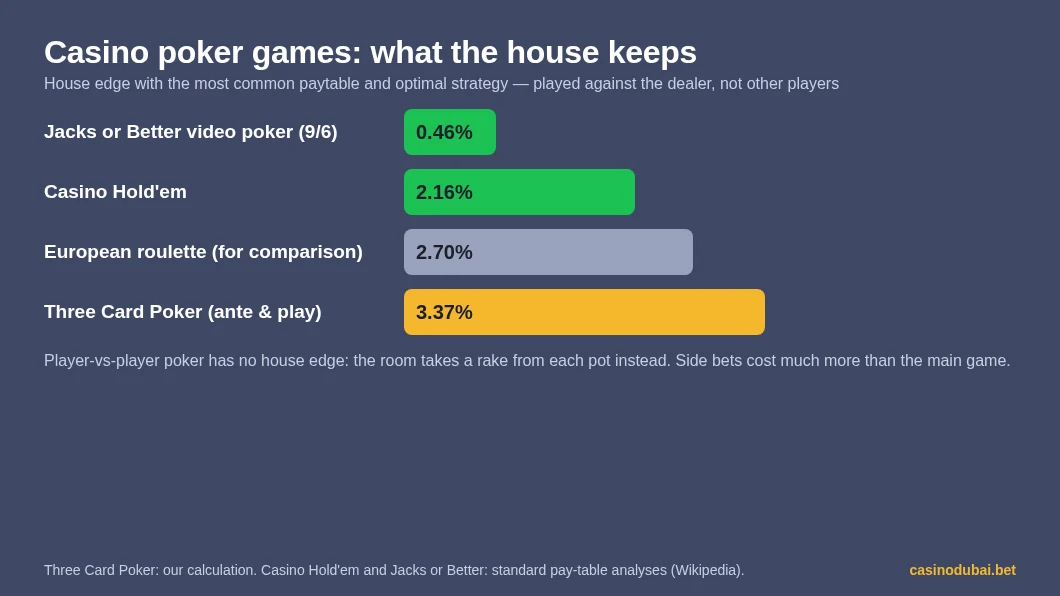
Casino poker games borrow poker hands but are played against the dealer at a fixed paytable. These are the main ones for the most common paytables and optimal strategy:
| Game | How it works | House edge |
|---|---|---|
| Casino Hold’em | Ante, then call (2× the ante) or fold after the flop; the dealer qualifies with a pair of fours | 2.16% of the ante |
| Three Card Poker (Ante and Play) | Three cards each; the dealer qualifies with queen-high | 3.37% of the ante |
| Jacks or Better video poker (9/6 paytable) | Draw poker against a paytable; a pair of jacks or better pays | 0.46% (return 99.54%) |
Three Card Poker: our calculation, counting every possible deal and playing queen-6-4 or better. Casino Hold’em and Jacks or Better: standard pay-table analyses published on Wikipedia. Ultimate Texas Hold’em and Caribbean Stud are not in the table because their return depends on the casino’s pay table — check it in each game’s rules panel. Side bets, such as Pair Plus or progressive jackpots, carry much higher house edges.
For comparison, European roulette has a house edge of 2.7% and well-played blackjack around 0.5% — see our roulette guide and blackjack guide. Video poker is the exception that rewards study: on a full-pay 9/6 Jacks or Better machine, perfect strategy brings the house edge below half a percent, but machines that pay less for a full house or a flush (8/5, 7/5) cost noticeably more. Check the paytable before you play.
Casino Hold’em, Ultimate Texas Hold’em and Three Card Poker are also dealt by real dealers on video stream; our live casino guide explains how those tables work.
Poker Tournaments vs Cash Games
| Item | Cash game | Tournament |
|---|---|---|
| Chips | Worth real money | Tournament chips with no cash value |
| Entry | Buy in for any amount within the table limits | Fixed buy-in plus a fee |
| Leaving | Any time, with your chips | Only when you are knocked out or the tournament ends |
| Blinds | Fixed | Rise at set intervals |
| Prizes | Whatever you win at the table | Paid to the top finishers, usually 10–15% of the field |
Tournaments cap your loss at the buy-in, which suits a fixed budget; cash games let you leave at any time but can cost far more in a single session.
Poker in Dubai and the UAE: Is It Legal?
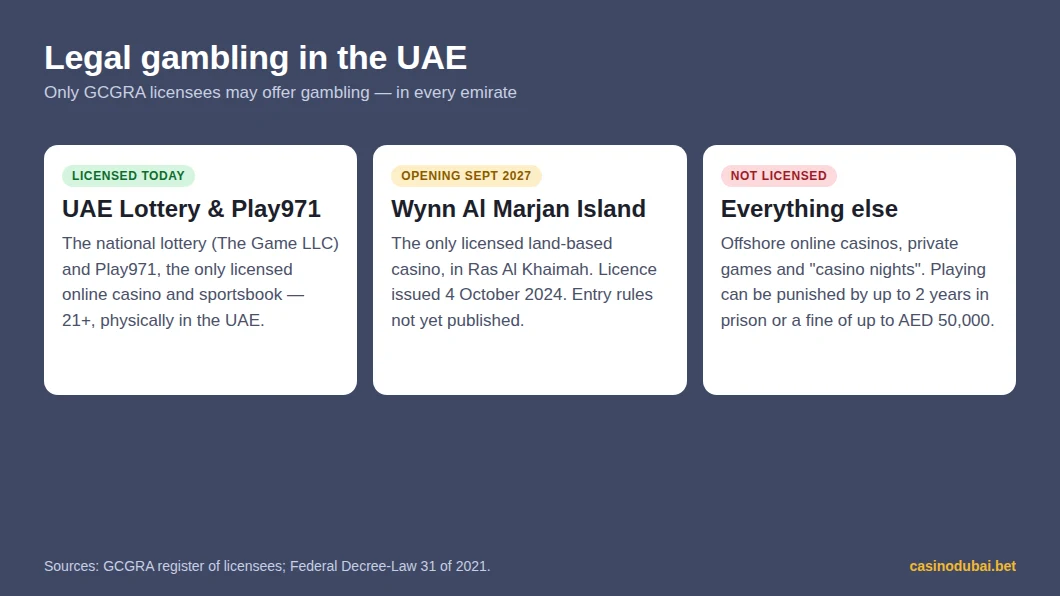
Poker played for money is gambling, and in the UAE gambling is legal only through operators licensed by the federal regulator, the General Commercial Gaming Regulatory Authority (GCGRA). Outside that system the Crimes and Penalties Law (Federal Decree-Law No. 31 of 2021) applies: Article 461 punishes whoever gambles with up to two years in prison or a fine of up to AED 50,000, and Article 462 punishes whoever organises gambling with up to ten years and a fine of at least AED 100,000. Our UAE gambling laws guide explains the full framework.
For poker, that has three practical consequences:
- Private games for money are not a grey area. A home game, a “club” or an organised night with a buy-in falls under the same law as any other unlicensed gambling — and running it is the more serious offence.
- Offshore poker sites are unlicensed in the UAE. Whatever licence they hold abroad, only the GCGRA can authorise gambling in the UAE.
- The licensed route is narrow. Play971 is the only online casino with a GCGRA licence, and Wynn Al Marjan Island, the first licensed casino resort, is not open yet.
Many readers also ask whether Muslims may play poker. Gambling — maysir — is prohibited in Islam, which is one of the reasons UAE law has long treated it as an offence. Card games played without stakes are a different matter: games such as baloot and tarneeb are part of social life across the Gulf.
Poker on Play971
Play971, run by Coin Technology Projects LLC, is the only online casino licensed by the GCGRA. When it launched in December 2025, Gulf News listed poker among its products. When we opened its live lobby from the UAE on 22 October 2026, its 30 live tables were all roulette, blackjack, baccarat and Dragon Tiger — there was no live poker table — and its digital blackjack category included Blackjack Poker and Pairs, a blackjack game with a poker-hand side bet. Play is in dirhams, you must be 21 or over and physically in the UAE, and accounts are verified with an Emirates ID. Our Play971 guide explains how to register and pay.
Poker at Wynn Al Marjan Island
Wynn Al Marjan Island in Ras Al Khaimah holds the UAE’s only licence for a land-based casino and is expected to open in September 2027. Wynn has not yet published its table mix, so whether it will deal poker cash games or tournaments — and on what terms residents can enter — is still to be announced. On 4 October 2024 the GCGRA issued the resort’s operating company, listed on its register as Island 3 AMI FZ-LLC, the UAE’s first commercial gaming facility licence. Wynn has not yet published the size of the gaming floor, its entry rules or the minimum age, and a 2023 report that UAE citizens would not be admitted has not been confirmed in any published regulation. We will update this guide when it is.
PokerStars, GGPoker and Offshore Poker Sites
The big international poker brands are among the most searched in the UAE — “ggpoker” has about 200 searches a month and “pokerstars” about 150, according to Ahrefs. None of them is licensed by the GCGRA. PokerStars.com, for example, is operated by TSG Interactive Gaming Europe Limited under a licence from the Malta Gaming Authority, according to its own footer. A Maltese, Isle of Man or Curaçao licence lets a poker room serve the markets those regulators allow; it does not authorise real-money play in the UAE.
Playing on an offshore site from the UAE adds practical risks on top of the legal one. Poker rooms’ terms typically forbid VPNs and allow them to close accounts and keep balances when they detect play from a country they do not serve. Withdrawals require identity checks, and there is no UAE authority to complain to if a site does not pay. If you are thinking of crypto-based poker rooms, our crypto casinos guide explains the same issues in detail.
Free Poker and Play-Money Apps
In the UAE, the top search results for “poker” are free poker apps on Google Play and the App Store. These “social” poker games use play chips that cannot be cashed out, and make money by selling more chips as in-app purchases. They are a reasonable way to learn the rules and the hand rankings, with two cautions: buying chips is real spending even if the chips are not real money, and any app or group that lets you sell chips for cash, or “agents” who offer to, has turned the game into unlicensed gambling.
Play-money games also teach less than they seem to: with nothing at stake, players call and bluff far more often than at a real table, so habits learned there rarely carry over.
Poker Strategy Basics
Whole libraries exist on poker strategy. Five principles explain most of the difference between beginners and solid players:
- Play fewer hands. Most two-card hands lose money. Strong players fold the large majority of their starting hands, especially from early positions.
- Position matters. Acting last in a betting round — on or near the button — lets you see what others do before you decide. The same cards are worth more in late position.
- Bet for a reason. Every bet should either get called by worse hands or fold out better ones. A bet that does neither just costs chips.
- Use pot odds. Call with a draw only when your chance of hitting beats the price, as in the example above.
- Manage your bankroll. Only sit at stakes where a bad run cannot hurt you. Cash-game players commonly keep many buy-ins in reserve, because even good players lose for long stretches.
None of this changes the casino poker games, where the paytable sets the house edge; there, the only strategy is to follow the optimal decision chart and avoid the side bets.
Common Poker Mistakes
| Mistake | Why it costs | What to do instead |
|---|---|---|
| Playing too many hands | Weak hands lose more often than they win | Start with strong hands and fold the rest |
| Overvaluing one pair | With seven cards, someone often has more | Slow down when the board is coordinated or the betting is heavy |
| Chasing draws at any price | A gutshot hits only one time in six by the river | Compare your odds with the pot odds |
| Bluffing too often | Bluffs work only when the story is believable | Bluff rarely, and against few opponents |
| Playing tired, upset or after a big loss | Decisions get worse — “tilt” | Stop the session |
| Taking side bets in casino poker | Their house edge is much higher than the main game | Stick to the ante and play bets |
Most of these mistakes come down to the same thing: putting chips in without a reason the odds support.
Poker Glossary
| Term | Meaning |
|---|---|
| Blinds | Forced bets posted by the two players left of the button |
| Button | Marker for the nominal dealer; the best position at the table |
| Board | The shared cards in the middle |
| Flop, turn, river | The third, fourth and fifth shared cards’ betting rounds |
| Hole cards | Your private cards |
| Kicker | The side card that breaks ties between equal hands |
| Nuts | The best possible hand on a given board |
| Outs | Cards that would improve your hand to a likely winner |
| Pot odds | The ratio of the pot to the cost of calling |
| Rake | The operator’s share of each pot |
| Set | Three of a kind made with a pocket pair |
| Side pot | A separate pot when a player is all-in for less |
| Tilt | Playing badly because of frustration |
Play Responsibly
Poker’s skill element makes it easy to believe that losses are temporary and that the next session will win them back. Decide your budget in dirhams before you sit down, never borrow to play, and stop when the budget is gone. Long sessions, chasing losses and hiding how much you play are warning signs. Confidential help is available from BeGambleAware.
FAQ
- Is poker legal in Dubai?
Not for money, unless it is offered by a GCGRA-licensed operator. Private games and offshore poker sites are unlicensed gambling under the Crimes and Penalties Law. Playing without stakes is not gambling.
- Can I play poker online in the UAE?
The only licensed online casino is Play971. On 22 October 2026 its live lobby had no poker tables; check its casino lobby for the games currently offered.
- What is the best hand in poker?
A royal flush: ace, king, queen, jack and ten of the same suit. It comes up once in 649,740 five-card hands.
- Is poker played with five or seven cards?
A hand is always five cards. In Texas Hold’em you choose the best five from seven: your two cards and five on the board.
- What are the odds of getting pocket aces?
1 in 221 hands. Any pocket pair comes once in 17 hands.
- Is poker a game of skill or luck?
Both. Each hand involves luck, but over many hands better decisions win money from weaker players. Casino poker games played against the dealer have a fixed house edge that skill cannot overcome.
- Which casino poker game has the lowest house edge?
Full-pay 9/6 Jacks or Better video poker, at about 0.46% with perfect strategy. Among table games, Casino Hold’em is about 2.2% with the most common pay table.
- Are PokerStars and GGPoker legal in the UAE?
No. They are licensed abroad, not by the GCGRA, so real-money play from the UAE is unlicensed gambling.
- Will Wynn Al Marjan Island have poker?
Wynn has not published its table mix. The resort is expected to open in September 2027.
- Are poker sets allowed in the UAE?
The law targets gambling — playing for money or valuables — rather than cards and chips themselves. Using a poker set for a game with real stakes is what makes it unlicensed gambling.