
Online Blackjack: Rules, Basic Strategy Chart and House Edge
Online blackjack is the card game in which you try to beat the dealer by getting closer to 21 without going over. With good rules and correct basic strategy, the house edge is around 0.4% to 0.6% — the lowest of any standard casino game.
Two things push it up quickly: a table that pays blackjack at 6:5 instead of 3:2, and decisions made by instinct rather than strategy. In the UAE, the only licensed place to play blackjack online is Play971.
Blackjack is the one casino game where your decisions change the odds. This guide explains the rules step by step, gives you the full basic strategy chart, shows what each table rule costs in dirhams, compares the live and RNG versions you will find online, and explains what card counting can and cannot do. It ends with where blackjack stands in the UAE: on Play971 today, and at the Wynn Al Marjan casino due to open in Ras Al Khaimah. Last reviewed: 21 October 2026.
Best Online Casinos to Play Blackjack in Dubai in 2026
These are the casinos we rate. The blackjack tables each one offers — and their rules, such as how blackjack is paid — vary by operator, so check a table’s help screen before you play. Play971, at the top, is the only one licensed by the UAE’s GCGRA; the others are licensed abroad. Keep the basic strategy chart open while you play.






Online Blackjack at a Glance
| Item | Details |
|---|---|
| Aim | Finish closer to 21 than the dealer without going over |
| Card values | 2–10 at face value; J, Q, K = 10; ace = 1 or 11 |
| Blackjack | Ace plus a 10-value card as your first two cards — pays 3:2 at a good table |
| House edge with basic strategy | About 0.4%–0.6% with standard multi-deck rules |
| Biggest rule to check | Blackjack pays 3:2, not 6:5 — 6:5 adds about 1.4% to the house edge |
| Chance of being dealt blackjack | About 4.75% — roughly one hand in 21 |
| Insurance | A side bet with a house edge of about 7.4% — basic strategy never takes it |
| Licensed online blackjack in the UAE | Play971 only — nine digital blackjack games and live tables from AED 50 to AED 100,000 per hand |
How to Play Blackjack
Every blackjack round follows the same order:
01
Place your bet within the table’s minimum and maximum, plus any side bets you want.
02
The deal. You and the dealer each get two cards. Yours are face up; the dealer has one card face up — the “upcard” — and one face down, the “hole card”.
03
The dealer checks for blackjack. If the upcard is an ace or a 10, the dealer peeks at the hole card. If the dealer has blackjack, the round ends and you lose your bet unless you also have blackjack, which is a push (your bet is returned).
04
You play your hand. You hit, stand, double down, split or surrender, as explained below, until you stand or go over 21 (“bust”). A bust loses at once, even if the dealer busts later.
05
The dealer plays by fixed rules. The dealer has no choices: they must draw to 16 and stand on 17. Whether they stand or draw on a “soft” 17 — a 17 with an ace counted as 11 — is printed on the table.
06
Settlement. A hand closer to 21 than the dealer’s wins 1:1; a natural blackjack wins 3:2; equal totals push.
Card Values and Hand Totals
| Card | Value |
|---|---|
| 2 to 9 | Face value |
| 10, jack, queen, king | 10 |
| Ace | 1 or 11, whichever helps the hand |
A hand with an ace counted as 11 is soft — “soft 17” is ace-6, for example — because it cannot bust with one more card: if the next card takes it over 21, the ace simply counts as 1. A hand without an ace, or with the ace forced to count as 1, is hard. Hard 12 to 16 are the difficult hands, because one card can bust them but they are rarely good enough to stand against a strong dealer upcard.
Your Options: Hit, Stand, Double, Split, Surrender
| Option | What it does | When it is used |
|---|---|---|
| Hit | Take another card | When your total is low or the dealer shows a strong card |
| Stand | Keep your total and end your turn | When you are likely to bust, or the dealer is likely to |
| Double down | Double your bet and take exactly one more card | On 9, 10 or 11, and some soft hands, against weak dealer cards |
| Split | Turn a pair into two hands, adding a second bet of the same size | Always aces and 8s; never 10s or 5s |
| Surrender | Give up the hand and get half your bet back | Hard 16 against 9, 10 or ace, and hard 15 against 10, where offered |
| Insurance | A side bet of half your stake that the dealer has blackjack, paying 2:1 | Never, under basic strategy |
Doubling and splitting are where basic strategy makes most of its gains, and insurance is the one option the chart never uses.
Blackjack Basic Strategy
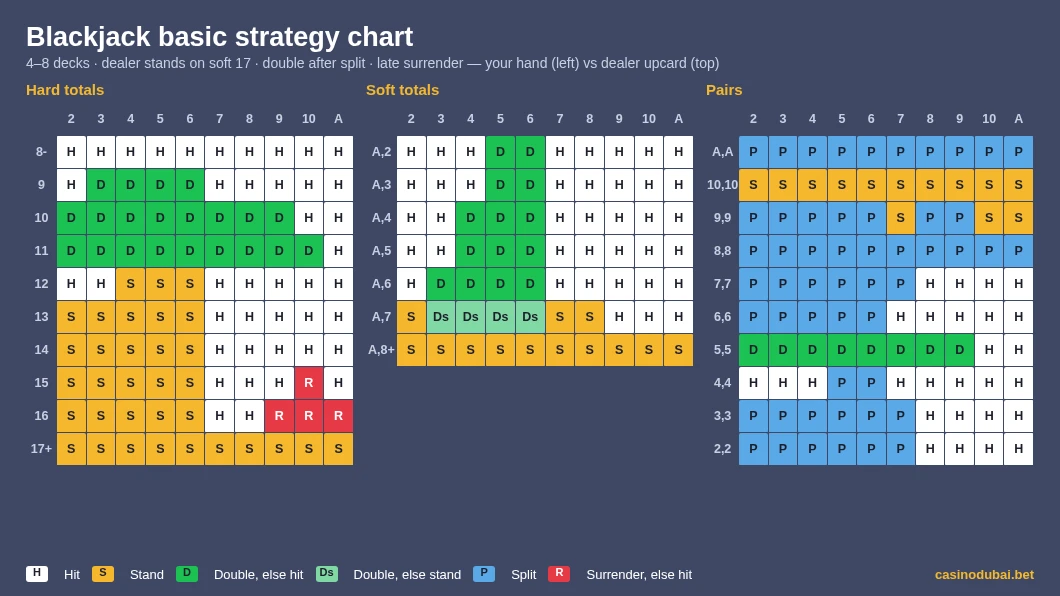
Basic strategy is the mathematically best decision for every combination of your hand and the dealer’s upcard. It was first worked out in 1956 by four US Army engineers — Roger Baldwin, Wilbert Cantey, Herbert Maisel and James McDermott — and later refined by computer. It does not guarantee a win; it guarantees that every decision costs you as little as possible. The chart below is for the most common online game: four to eight decks, dealer stands on soft 17, double after split allowed, late surrender.
Key: H = hit, S = stand, D = double (hit if doubling is not allowed), Ds = double (stand if not allowed), P = split, R = surrender (hit if not allowed).
Hard totals
| Your hand | 2 | 3 | 4 | 5 | 6 | 7 | 8 | 9 | 10 | A |
|---|---|---|---|---|---|---|---|---|---|---|
| 8 or less | H | H | H | H | H | H | H | H | H | H |
| 9 | H | D | D | D | D | H | H | H | H | H |
| 10 | D | D | D | D | D | D | D | D | H | H |
| 11 | D | D | D | D | D | D | D | D | D | H |
| 12 | H | H | S | S | S | H | H | H | H | H |
| 13–14 | S | S | S | S | S | H | H | H | H | H |
| 15 | S | S | S | S | S | H | H | H | R | H |
| 16 | S | S | S | S | S | H | H | R | R | R |
| 17 or more | S | S | S | S | S | S | S | S | S | S |
The pattern to remember: stand on 12–16 when the dealer shows 2 to 6, and hit them when the dealer shows 7 or higher.
Soft totals
| Your hand | 2 | 3 | 4 | 5 | 6 | 7 | 8 | 9 | 10 | A |
|---|---|---|---|---|---|---|---|---|---|---|
| A,2 – A,3 | H | H | H | D | D | H | H | H | H | H |
| A,4 – A,5 | H | H | D | D | D | H | H | H | H | H |
| A,6 | H | D | D | D | D | H | H | H | H | H |
| A,7 | S | Ds | Ds | Ds | Ds | S | S | H | H | H |
| A,8 – A,9 | S | S | S | S | S | S | S | S | S | S |
Soft hands are the ones to double most often, because an ace counted as 1 or 11 means a single extra card cannot bust you.
Pairs
| Your pair | 2 | 3 | 4 | 5 | 6 | 7 | 8 | 9 | 10 | A |
|---|---|---|---|---|---|---|---|---|---|---|
| A,A | P | P | P | P | P | P | P | P | P | P |
| 10,10 | S | S | S | S | S | S | S | S | S | S |
| 9,9 | P | P | P | P | P | S | P | P | S | S |
| 8,8 | P | P | P | P | P | P | P | P | P | P |
| 7,7 | P | P | P | P | P | P | H | H | H | H |
| 6,6 | P | P | P | P | P | H | H | H | H | H |
| 5,5 | D | D | D | D | D | D | D | D | H | H |
| 4,4 | H | H | H | P | P | H | H | H | H | H |
| 2,2 – 3,3 | P | P | P | P | P | P | H | H | H | H |
If the dealer hits soft 17, a few cells change: double 11 against an ace, double A,8 against a 6, double-or-stand A,7 against a 2, and surrender 15, 17 and a pair of 8s against an ace where allowed. Everything else stays the same.
The Basic Strategy Rules Worth Memorising
If the full chart is too much at first, these rules cover most of its value:
- Always split aces and 8s. Two hands starting with an ace are far stronger than soft 12; 16 is the worst total in the game.
- Never split 10s or 5s. Twenty is already a winning hand, and 10 is a doubling hand.
- Double 11 against every dealer card except an ace, and double 10 against 2 to 9.
- Stand on hard 12 to 16 against a dealer 2 to 6 — except hit 12 against 2 or 3. Let the dealer take the risk of busting.
- Hit hard 12 to 16 against 7 or higher. Standing on 16 against a 10 loses more often than hitting.
- Always stand on hard 17 or more, and on soft 19 or more.
- Never take insurance or “even money”.
Why Basic Strategy Works: The Dealer’s Bust Odds
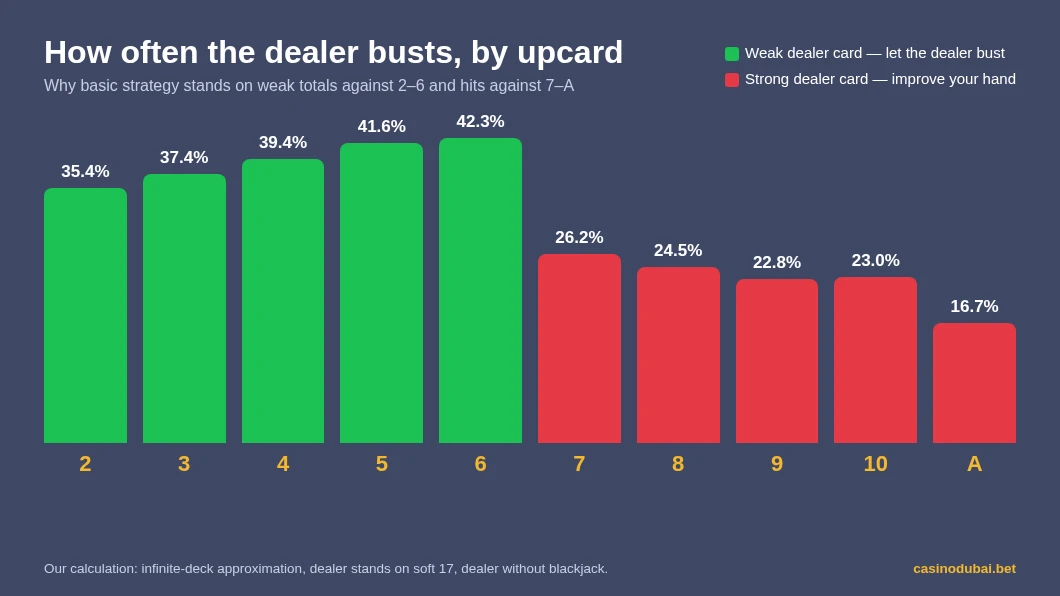
The logic of the chart comes from one fact: the dealer has no choices. With a weak upcard, the dealer is forced to draw into a likely bust, so you can stand on a weak total and let that happen. With a strong upcard, the dealer will usually finish on 17 or more, so a weak total will lose unless you improve it.
| Dealer upcard | Chance the dealer busts | What it means for you |
|---|---|---|
| 2 | 35.4% | Fairly weak — stand on 13 or more |
| 3 | 37.4% | Weak — stand on 13 or more |
| 4 | 39.4% | Weak — stand on 12 or more |
| 5 | 41.6% | Very weak — double and split aggressively |
| 6 | 42.3% | The dealer’s worst card |
| 7 | 26.2% | Strong — hit up to 16 |
| 8 | 24.5% | Strong |
| 9 | 22.8% | Strong |
| 10 | 23.0% | Very strong |
| Ace | 16.7% | The dealer’s best card |
Our calculation: infinite-deck approximation, dealer stands on soft 17, given that the dealer does not have blackjack. Real six- and eight-deck figures differ by a fraction of a percentage point.
The dealer busts most often with a 5 or 6 showing — more than four times in ten — which is why basic strategy stands on weak totals against those cards.
House Edge: What Each Table Rule Costs
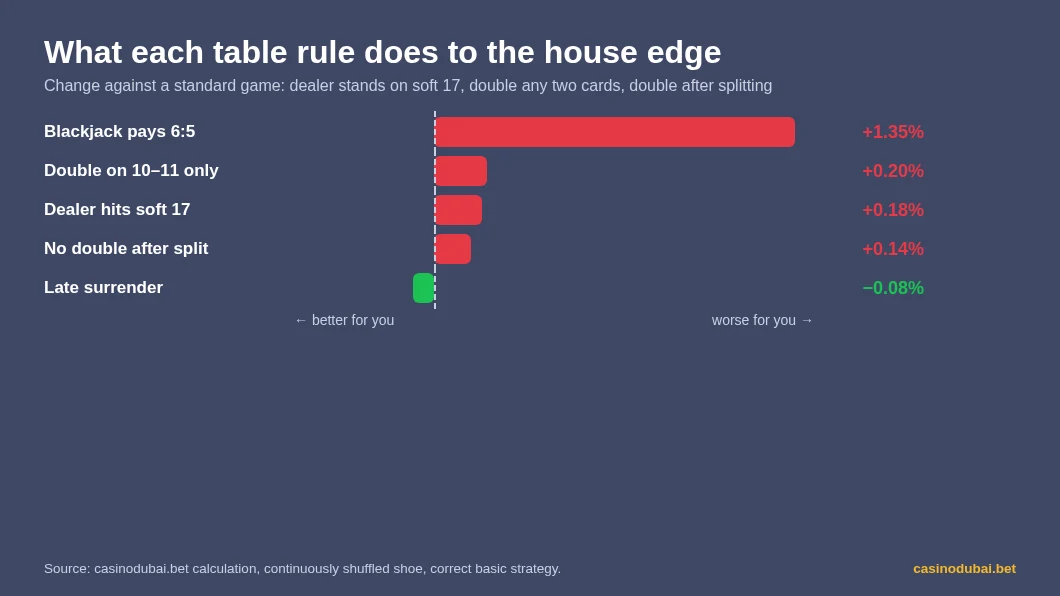
Blackjack does not have one house edge; each table’s rules set it. A standard eight-deck game in which the dealer stands on soft 17 and you may double any two cards and double after splitting is the reference. Against that, these are the effects we calculated for a continuously shuffled shoe — very close to the six- and eight-deck shoes used online — assuming correct basic strategy:
| Rule | Effect on the house edge |
|---|---|
| Blackjack pays 6:5 instead of 3:2 | +1.35% |
| Blackjack pays 1:1 (even money) | +2.26% |
| Double on 10 or 11 only | +0.20% |
| Dealer hits soft 17 | +0.18% |
| No doubling after splitting | +0.14% |
| Late surrender allowed | −0.08% |
By our calculation the reference game has a house edge of about 0.41%, and adding late surrender brings it to about 0.33%. Using fewer decks lowers the edge slightly. In practice, most online and live tables sit between 0.4% and 0.6%. The single number that matters most is the blackjack payout: never play 6:5 blackjack. It more than triples the house edge of a good game.
Blackjack in Dirhams: What the Edge Means
| 100 hands at AED 50 | Good rules, basic strategy (0.5%) | 6:5 blackjack (about 1.9%) | Playing by instinct (about 2%–3%) |
|---|---|---|---|
| Total wagered | AED 5,000 | AED 5,000 | AED 5,000 |
| Expected loss | About AED 25 | About AED 95 | About AED 100–150 |
Our illustration. Expected loss = total wagered × house edge. Doubles and splits add to the amount wagered, so real figures are a little higher. The cost of playing by instinct varies with the player.
Compared with a slot at a 96% RTP, which costs AED 4 per AED 100 wagered, a well-played blackjack hand costs about 50 fils per AED 100. That is why blackjack bets often count for little or nothing towards casino bonus wagering requirements.
Insurance and Even Money
When the dealer shows an ace, you are offered insurance: a side bet of up to half your stake that pays 2:1 if the dealer has blackjack. It sounds like protection, but it is a separate bet on whether the hole card is a 10. In an eight-deck shoe, about 30.8% of the remaining cards are 10s — fewer than the one-in-three needed to break even at 2:1. The result is a house edge of about 7.4% with six or eight decks (our calculation). “Even money” — taking 1:1 at once on your own blackjack when the dealer shows an ace — is the same insurance bet in disguise, and should also be declined.
Live Blackjack vs RNG Blackjack
| Item | RNG (digital) blackjack | Live dealer blackjack |
|---|---|---|
| Cards | Dealt by a random number generator, usually reshuffled every hand | Real cards from a shoe, usually eight decks |
| Speed | As fast as you click | About the pace of a real table |
| Minimum stakes | Often very low | Higher — for example AED 50 on Play971’s standard tables |
| Seats | You alone | Usually seven seats, with “bet behind” when full |
| Card counting | Useless — the deck is reshuffled | Limited — the shoe is cut and reshuffled long before the end |
| Rules and edge | Set by the game; check the help screen | Set by the table; check the help screen |
Because a live game is slower, you play fewer hands per hour, so the same house edge costs less per hour. RNG blackjack is useful for practising basic strategy at low stakes.
Live Blackjack Variants
The large live studios have built variations on classic blackjack. These are the best known, all from Evolution; the return figures are those given in each game’s rules for optimal play of the main bet.
| Variant | How it differs | Return on the main bet |
|---|---|---|
| Classic live blackjack | Seven seats, eight decks, standard rules | Around 99.4%–99.6%, depending on the table rules |
| Infinite Blackjack | Unlimited players share one dealt hand and each make their own decisions; a 6-card Charlie wins | 99.47% |
| Lightning Blackjack | Winning hands can carry multipliers into the next round, paid for by a fee on each hand | 99.56% |
| Free Bet Blackjack | Free doubles on hard 9–11 and free splits on most pairs, but a dealer 22 pushes | 98.45% |
| Power Blackjack | All 9s and 10-spot cards removed (jacks, queens and kings stay); you can double, triple or quadruple down | 98.80% |
The variants change the strategy as well as the payouts — Free Bet Blackjack, for example, makes it right to take every free double. If you play one, learn its own strategy rather than the classic chart.
Blackjack Side Bets
Most online tables offer optional side bets placed before the deal. They pay large multiples, but every one of them has a far higher house edge than the main game.
| Side bet | Wins when | Typical pays | House edge |
|---|---|---|---|
| Perfect Pairs | Your first two cards are a pair | 25:1 perfect pair, 12:1 coloured pair, 6:1 mixed pair | About 4.1% (eight decks) |
| 21+3 | Your two cards plus the dealer’s upcard make a poker hand | From 5:1 (flush) to 100:1 (suited trips) | Roughly 3%–4%, depending on the pay table |
| Insurance | The dealer has blackjack | 2:1 | About 7.4% |
Perfect Pairs (25:1, 12:1, 6:1) and 21+3 (100:1 down to 5:1): our calculation for eight decks, counting every combination — 4.10% and 3.70%. Insurance: our calculation.
Every side bet costs several times more than the main game played with basic strategy, at about 0.4% to 0.6%, and insurance is the most expensive of the three.
Blackjack Compared With Other Casino Games
| Game | Typical house edge | Do your decisions matter? |
|---|---|---|
| Blackjack, basic strategy, good rules | 0.4%–0.6% | Yes |
| Baccarat — Banker bet | 1.06% | No |
| French roulette — even-money bets | 1.35% | No |
| Blackjack paying 6:5 | About 1.8%–2% | Yes |
| European roulette | 2.70% | No |
| Slots | Typically 3%–6% | No |
Our roulette guide and slots guide cover those games in depth, our crash games guide covers Aviator and other fast games, and the casino games guide compares every category.
Card Counting: What It Can and Cannot Do
Card counting became famous after the mathematician Edward Thorp published Beat the Dealer in 1962. The idea is simple: low cards leaving the shoe make the remaining cards richer in 10s and aces, which favours the player. A counter keeps a running score — in the common Hi-Lo system, +1 for 2–6, −1 for 10s and aces — and bets more when the count is high.
- It is not illegal in itself, but land-based casinos can refuse to deal to counters.
- It does not work online at RNG tables, which reshuffle every hand.
- It barely works at live tables: the eight-deck shoe is cut early and reshuffled, and the gain needs a large bankroll and long play.
- “Systems” sold online that promise to beat blackjack without counting — betting progressions such as Martingale — do not change the house edge at all.
Blackjack Myths
| Myth | Reality |
|---|---|
| “Assume the hole card is a 10” | A useful shortcut for beginners, but basic strategy already accounts for every possible hole card |
| “Bad players at the table hurt you” | Other players’ choices change which cards you get, but not the odds — they are as likely to help as to hurt |
| “Take insurance when you have a good hand” | Insurance is a bet on the dealer’s hole card; your hand does not change its value |
| “Never bust — always stand on 12 or more” | Standing on 12–16 against a 7 or higher loses more money than hitting |
| “After a losing streak you are due a win” | Each hand is independent, especially at RNG tables that reshuffle |
| “Raising your bet after losses beats the game” | Betting systems change the size of your swings, not the house edge |
Each myth comes down to the same mistake — believing that the last hand affects the next one; only the rules of the table and your decisions change the odds.
A Short History of Blackjack
Blackjack descends from vingt-et-un (“twenty-one”), a card game played in French casinos from the eighteenth century. It reached the United States in the nineteenth century, and the name “blackjack” is usually explained by a bonus some American gambling houses paid for a hand of the ace of spades with a black jack — a bonus long since dropped, though the name stayed.
Nevada legalised casino gambling in 1931, and blackjack became a fixture of Las Vegas. The 1956 paper by Baldwin, Cantey, Maisel and McDermott worked out the first basic strategy, and Thorp’s 1962 book showed that the game could be beaten by counting cards — which led casinos to add decks, use shoes and cut cards, and later continuous shuffling machines. Online blackjack arrived with the first internet casinos in the mid-1990s, and live dealer blackjack streamed from studios became the standard in the 2010s.
Blackjack on Play971
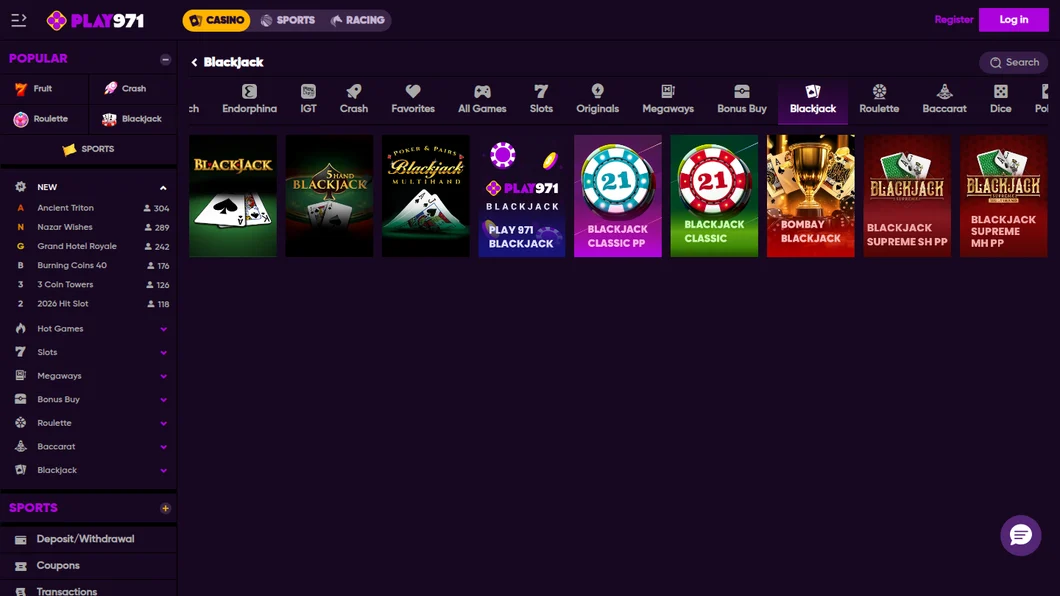
Play971, run by Coin Technology Projects LLC, is the only online casino licensed by the UAE’s federal regulator, the GCGRA, so it is the only place where people in the UAE can legally play blackjack online. Opened from the UAE on 21 October 2026, its Blackjack category listed nine digital games — Blackjack, 5 Hand Blackjack, Blackjack Poker and Pairs, Play971 Blackjack, Blackjack Classic, Blackjack Classic PP, Bombay Blackjack, Blackjack Supreme SHPP and Blackjack Supreme MHPP — and its live casino had these blackjack tables, with limits per hand in dirhams:
| Table | Limits per hand |
|---|---|
| American Blackjack | AED 50 – 20,000 |
| American Blackjack 2 | AED 100 – 20,000 |
| VIP American Blackjack | AED 1,000 – 100,000 |
Play is in dirhams, you must be 21 or over and physically in the UAE, and accounts are verified with an Emirates ID. Check each table’s rules in the game’s help screen — in particular how blackjack is paid and whether the dealer hits soft 17 — before you play.
Blackjack at Wynn Al Marjan Island
The UAE has no casino open yet. The first, Wynn Al Marjan Island in Ras Al Khaimah, holds the GCGRA’s only land-based gaming licence and is expected to open in September 2027. The GCGRA lists blackjack among the typical games of a licensed land-based facility, and one of its licensed suppliers, TCS John Huxley, makes table-game equipment and card shufflers. Table rules and limits will be set by the operator and approved by the regulator. Our Ras Al Khaimah casino guide explains who will be allowed in.
The licence itself is already in place: on 4 October 2024 the GCGRA issued the resort’s operating company, listed on its register as Island 3 AMI FZ-LLC, the UAE’s first commercial gaming facility licence.
Is Online Blackjack Legal in the UAE?
Only on Play971. Gambling in the UAE is legal only through operators licensed by the GCGRA. Blackjack at offshore online casinos — including those licensed in Curaçao, Malta or Anjouan — is unlicensed gambling under UAE law: Article 461 of the Crimes and Penalties Law (Federal Decree-Law No. 31 of 2021) punishes whoever gambles with up to two years in prison or a fine of up to AED 50,000. Free blackjack games with no cash prizes are a different matter. Our UAE gambling laws guide explains the full picture.
On Play971 you can play blackjack legally in dirhams, at digital and live tables — see Blackjack on Play971 above for the tables and limits.
How to Choose a Blackjack Table
01
Check the blackjack payout. It must be 3:2. Walk away from 6:5.
02
Check the dealer rule on soft 17. “Dealer stands on soft 17” is better for you.
03
Look for doubling after splitting and late surrender. Both lower the house edge.
04
Pick limits that fit your budget. Your bankroll should cover at least 30–40 minimum bets.
05
Ignore the side bets, or treat them as a small entertainment cost.
06
Keep the basic strategy chart open until you know it.
Common Blackjack Mistakes
- Playing 6:5 tables — the most expensive mistake in the game.
- Taking insurance or even money.
- Standing on 12–16 against a 7, 8, 9, 10 or ace out of fear of busting.
- Not doubling 10 or 11 against weak dealer cards.
- Splitting 10s or failing to split 8s.
- Chasing losses by raising bets after a bad run.
- Playing bonus money on blackjack without checking whether it counts towards the wagering requirement — see our bonuses guide.
Blackjack on Mobile
Live and RNG blackjack both work in a phone browser, and the decision buttons are designed for touch. On a small screen, keep the strategy chart in a second tab, or learn the short rules above. Play971 has no app; it runs in the browser at play971.ae. Our casino apps guide explains the difference between apps and mobile sites.
Because Play971 must confirm that you are in the UAE, it checks your location on mobile too: its help centre tells Android users to give the browser permission for precise location, and its games will not open with location services switched off. Any download that calls itself the “Play971 app” does not come from the operator.
Blackjack Glossary
| Term | Meaning |
|---|---|
| Natural / blackjack | An ace and a 10-value card as the first two cards |
| Upcard / hole card | The dealer’s face-up card / face-down card |
| Hard hand | A hand with no ace counted as 11 |
| Soft hand | A hand with an ace counted as 11 |
| Bust | Going over 21 |
| Push | A tie — your bet is returned |
| H17 / S17 | Dealer hits / stands on soft 17 |
| DAS | Double after split allowed |
| Late surrender | Giving up half your bet after the dealer checks for blackjack |
| Shoe | The box holding several decks |
| Penetration | How far into the shoe cards are dealt before reshuffling |
| Bet behind | Betting on another player’s hand at a full live table |
| Basic strategy | The best decision for every hand against every upcard |
Play Responsibly
Blackjack’s low house edge makes it one of the cheaper casino games, but it is still a game you are expected to lose over time. Decide your budget in dirhams before you sit down, choose a stake that gives you plenty of hands, and stop when the budget is gone. Never raise your bets to win back losses. If gambling is no longer fun, or you are hiding it from people close to you, confidential help is available from BeGambleAware.
FAQ
- Is online blackjack legal in the UAE?
Only at Play971, the single online casino licensed by the GCGRA. Playing at offshore casinos from the UAE is unlicensed gambling.
- What is the house edge in blackjack?
About 0.4%–0.6% with standard rules and correct basic strategy. Paying blackjack at 6:5 adds about 1.4%.
- What does blackjack pay?
A natural blackjack pays 3:2 at a good table — AED 150 on an AED 100 bet. Other winning hands pay 1:1.
- Should I ever take insurance?
No. It is a side bet with a house edge of about 7.4%. Basic strategy never takes insurance or even money.
- What is soft 17?
A hand of 17 with an ace counted as 11, such as ace-6. Tables where the dealer stands on soft 17 are better for the player.
- Does card counting work online?
Not at RNG tables, which reshuffle every hand, and only marginally at live tables, which reshuffle the shoe early.
- What is the best online blackjack variant?
A classic table paying 3:2, with the dealer standing on soft 17 and late surrender. Among Evolution’s variants, Lightning and Infinite Blackjack have the highest stated returns.
- Is there a casino with blackjack in Dubai?
No. The first licensed casino in the UAE, Wynn Al Marjan Island in Ras Al Khaimah, is expected to open in September 2027.
- Can you win at blackjack in the long run?
Not with basic strategy alone — it reduces the house edge but does not remove it. Only card counting in favourable conditions can tip it, and those conditions barely exist online.
- How often do you get blackjack?
About 4.75% of hands — roughly once every 21 hands — in a six- or eight-deck game.